If you need precise, even heat for round-bottom flasks, these heated mantles with or without stirring help maintain uniform temperatures across diverse volumes. This guide highlights five reliable options suited for different flask sizes and applications—from small-scale synthesis to larger distillations. Best for beginners, students, or professionals who require steady heat and gentle agitation for chemical reactions or distillations.
Summary table of selected products:
| Product | Flask Size | Best For | Key Benefit |
|---|---|---|---|
| JOANLAB Electric 500ml Heating Mantle | 500 ml | Small-scale chemistry | Accurate digital control with stirring |
| GOYOJO Heating Mantle 1000 ml | 1000 ml | Medium-scale distillation | PID control, high stirring speed |
| JOANLAB Electric 1000 ml Heating Mantle | 1000 ml | Medium/large experiments | Dual heating and stirring with precise control |
| Heating Mantle Fisatom 2000 ml | 2000 ml | Large-volume applications | High capacity with uniform heat |
| Heating Mantle Fisatom 250 ml | 250 ml | Compact setups | Smaller footprint with reliable control |
JOANLAB Electric 500ml Heating Mantle With Magnetic Stirrer

This 500 ml JOANLAB mantle offers integrated stirring and digital temperature control. It uses a nickel-chrome heater in a high-temperature insulation layer to provide rapid heat-up with uniform heat distribution. The device is best for small-volume reactions where consistent heat is critical and stirring is desired to promote even heating.
- Best for compact lab setups and student projects requiring stable heating and mixing.
- Pros: precise digital control, stirrer function, energy efficiency, safety features.
- Limitations: 500 ml capacity may limit larger-volume experiments.
GOYOJO Heating Mantle With Magnetic Stirrer (1000 ml)
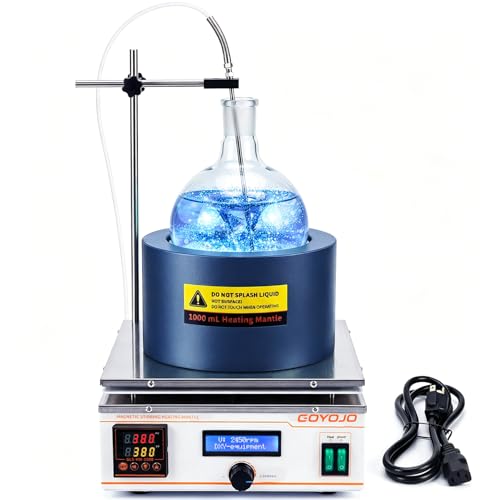
The GOYOJO unit combines heating and stirring for up to 1000 ml flasks, suitable for distillation, crystallization, and purification tasks. It uses industrial-grade self-tuning PID control to minimize overshoot and stabilize temperatures quickly, which improves reproducibility in routine experiments.
- Best for mid-sized experiments where both heating and constant agitation are needed.
- Pros: strong stirring speed, wide temperature range up to 380°C, reliable PID control.
- Limitations: 1000 ml capacity may be insufficient for larger-scale runs.
JOANLAB Electric Laboratory 1000ml Heating Mantle

This 1000 ml JOANLAB mantle emphasizes a robust digital temperature control system with an electronic regulation model and stepless speed adjustment. Its hemispherical heater and sealed wire design support fast warm-up, even high-temperature distribution, and safety for glassware, with optional stirring for improved heat transfer.
- Best for laboratories needing precise control at 1000 ml scale with quiet operation.
- Pros: reliable heat uniformity, integrated stirring option, compact for its capacity.
- Limitations: data suggests a focus on stability over extreme continuous duty.
Heating Mantle Fisatom 2000 ml (Round Bottom Flask)

The Fisatom 2000 ml mantle is designed for large-volume applications. It features reinforced thermal isolation for energy efficiency, a replaceable heater cartridge, and epoxy-coated aluminum housing. This unit accommodates up to 2000 ml round-bottom flasks and supports stable heating and stirring for extensive experiments.
- Best for larger batches or parallel reactions requiring higher capacity.
- Pros: high heat capacity, uniform distribution, replaceable heater cartridge.
- Limitations: larger footprint; more power consumption than smaller mantles.
Heating Mantle Fisatom 250 ml (Round-Bottom Flask)

The 250 ml Fisatom mantle is a compact option with epoxy-coated aluminum housing and a replaceable heater cartridge. It is suitable for small-scale experiments or teaching labs where space is limited but precise temperature control is still important. It supports uniform heating and stirring for small flasks.
- Best for classrooms or bench-top setups needing a small, controllable unit.
- Pros: small footprint, reliable temperature control, easy to replace parts.
- Limitations: limited to smaller flasks; less power for rapid heating.
Buying Guide: Key Considerations For Round Bottom Flask Heaters
- What flask sizes will you use most often? Choose a mantle that fits your typical volumes (e.g., 250–1000 ml for bench work, 2000 ml for larger runs).
- Is stirring important for your work? If you need uniform heating, prefer mantles with integrated magnetic stirrers or detachable stirring capability.
- What temperature range is required? Look for mantles with wide ranges and stable PID or digital controls to minimize overshoot.
- What material and build quality matter? Epoxy-coated aluminum housings offer durability and corrosion resistance; ensure heater cartridges are replaceable for long-term cost efficiency.
- Power and safety features: Check insulation quality, over-temperature protection, and energy efficiency to reduce glassware damage and heat loss.
- Portability vs. capacity: Smaller mantles save space but may lack power; larger mantles offer capacity and speed but require more bench space.
- Maintenance and parts: Favor models with accessible replacement parts and straightforward maintenance routines.
FAQ
- What is the main advantage of a heating mantle with a stirrer? It provides uniform heating and improved mixing, reducing hot spots and enabling consistent reaction conditions.
- Can these mantles be used with all round-bottom flasks? Most are designed for common sizes, but always verify the maximum flask diameter and volume in the product specs.
- Are digital temperature controls safer than analog ones? Yes, digital controls offer precise setpoints and faster stabilization, reducing the risk of overheating.
- Do mantles require calibration? Some units have self-tuning PID controls, but periodic checks against a thermometer or standard may help ensure accuracy.
- What maintenance is recommended for long-term use? Regularly inspect heating elements, clean surfaces, and replace worn heater cartridges as needed.
- Which mantle is best for beginners? A compact 250–500 ml unit offers straightforward operation and helpful safety features for new labs.