Looking for an efficient pump to move water around your property? This guide highlights five reliable options suited for different uses—from simple garden drainage to pool maintenance and basement pumping. Each entry notes who benefits most, why it’s a strong pick, and a pragmatic caveat. Below, compare key features to find the right balance of power, portability, and ease of use for your needs.
| Product | Best For | |
|---|---|---|
| TecHome Water Transfer Pump | Homeowners needing a lightweight, portable transfer pump | Compact design with included suction hose and ease of use |
| Limodot Submersible Pump | Basements, pools, and ponds needing higher flow | High flow rate and long power cord for flexibility |
| Aquastrong Sump Pump | Heavy-duty drainage with moderate power needs | High-capacity, solid build, decent suction |
| Pool Cover Pump (AgiiMan) | Above-ground pools and outdoor water removal | Debris filters and rugged exterior for outdoor use |
| ECO-WORTHY 33-Series Diaphragm Pump | Low-pressure irrigation or water systems with pressure control | Smart pressure switch and adjustable range |
Tip: For best results, choose a pump with the appropriate lift height (vertical feet pumped) and discharge size matching your hoses and outlets. Consider whether you need a submersible unit or an external pump, and whether you require a long power cord or extra adapters for compatibility with existing fittings.
TecHome Water Transfer Pump

- Type: Non-submersible transfer pump.
- Voltage: 115V / 60 Hz; Power: 1/10 HP; Flow: 330 GPH.
- Ports: 3/4 inch discharge and suction; Max lift 6 ft; Max head 40 ft.
- Includes 6 ft suction hose and water suction strainer; extra impeller kit.
- Best for: Small-to-moderate water transfers around the home, garden, or shed.
Best for buyers who want a lightweight, portable pump for occasional transfers and easy setup. It works well when you need quick water movement from a barrel, rain barrel, or container to another. Limitations: Not submersible, so keep the motor dry and elevate the source to avoid overheating.
Limodot Submersible Pump With 25ft Hose Kit

- Flow: Up to 4000 GPH (66 GPM); Lift: 31 ft.
- Includes 25 ft cord; lightweight (about 10.8 lbs) with a handle for portability.
- Low suction: can pull water from about 1/5 inch; outlet 1 1/2 inches with adapters for various fittings.
- Best for: Basements, pools, ponds, and other areas needing strong drainage with flexible hose connections.
- Caution: Submersible operation; ensure the water is clear of large debris to avoid clogs.
Choose this if you need substantial flow and flexible connectivity for coarse or debris-prone environments. Avoid if you require a dry-running option without water exposure to the motor or if the power cord length is insufficient for your setup.
Aquastrong Sump Pump 1 HP

- Flow: 4500 GPH; Lift: up to 30 ft; 1 HP motor.
- Bottom suction design; handles solids; 10 ft UL power cord.
- Discharge: 1-1/4″ NPT with adaptors for 1-1/2″ elbow and other fittings.
- Best for: Heavy drainage tasks, basements, hot tubs, and window wells where faster drainage is needed.
- Limitation: Heavier and less portable than smaller transfer pumps; consider transport needs.
Best for users needing high capacity drainage in challenging environments. This unit excels where rapid water removal is essential, but its size and weight make it less ideal for frequent moving between sites.
Pool Cover Pump Above Ground

- Flow: Up to 850 GPH; Power: 75W; 110V/60Hz.
- Waterproof level: IPX8; 10 ft power cord; ABS shell stands up to weather.
- Debris screens and mesh sides; suitable for outdoor pool covers and drainage.
- Best for: Clearing water from pool covers, window wells, and other outdoor surfaces.
- Limitation: Lower maximum lift than larger sump pumps; not ideal for deep drains.
Choose this for outdoor drainage tasks where weather resistance matters and a compact footprint is preferred. Avoid if you need long vertical pumping or high head pressure.
ECO-WORTHY 33-Series Diaphragm Pump
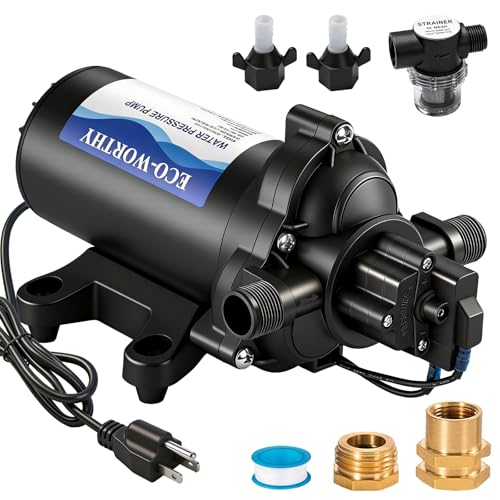
- Flow: 4.0 GPM; 50 PSI triggers auto on/off with water pressure; 110V AC.
- Self-priming up to 9.8 ft; lift up to 131 ft; adjustable 45-70 PSI.
- Features thermal overload protection for safety; suitable for irrigation and small water systems.
- Best for: Irrigation setups, RVs, or boats needing controlled pressure with automatic operation.
- Limitation: Lower flow compared with larger submersible pumps; not ideal for rapid drainage tasks.
Best for systems requiring precise pressure control and automatic cycling. It provides steady flow for irrigation or water transfer with less manual monitoring. It may be less suited for bulk water removal compared with high-flow sump pumps.
Buying Guide
What is your pumping duty?
For light, occasional transfers around the house, a small non-submersible pump (like TecHome) offers portability and ease of use. For rapid drainage of basements or ponds, prefer higher flow units with robust motors (e.g., Limodot or Aquastrong).
Submersible vs. non-submersible
Submersible pumps are ideal when you need to place the pump directly into water. Non-submersible pumps stay dry and require the water to be drawn to the pump via suction. Choose based on where the water is located and how accessible it is.
Flow rate and head height
Higher flow rates move more water per hour, but may require more power and create more noise. Check the maximum lift (vertical head) and ensure it matches the height you need to pump to avoid inefficiency.
Power, cords, and outlets
Consider the available power supply and cord length. Pumps with long cords or multiple adapters provide flexibility in placement, especially for outdoor or remote locations.
Durability and materials
Metal housings and corrosion-resistant components extend pump life in gritty or humid environments. Plastic housings are lighter, typically adequate for light-duty use.
Maintenance and compatibility
Look for pumps that include hoses, adapters, or strainers to simplify setup. Self-priming ability reduces manual effort, while spare parts like impellers help with long-term reliability.
Safety and energy use
Ensure the device has a safe switch and appropriate overload protection. For prolonged use, choose models with thermal protection to prevent overheating.
Summary of key considerations
- Small spaces: Opt for compact, portable units with quick setup.
- Frequent drainage: Choose higher flow, durable submersible models.
- Outdoor use: Prioritize IP-rated, weather-resistant construction.
- Irrigation or pressure needs: A diaphragm pump with a smart pressure switch can adapt to demand.
FAQ
- What is the difference between a submersible and a transfer pump?
Submersible pumps operate underwater; transfer pumps are typically surface devices used with hoses for water movement. - How much water can these pumps move per hour?
Range varies from around 330 GPH to 4500 GPH depending on model and configuration. - Can these pumps handle debris or solids?
Some models offer debris-filtering features or bottom suction designs; check each product for solids tolerance. - Do all pumps come with hoses and adapters?
Not all do; review included accessories and consider whether you need additional hoses or adapters. - Is a higher lift always better?
Higher lift enables pumping to greater heights, but it may reduce flow; balance lift with desired flow. - Are these pumps suitable for outdoor use?
Many are designed for outdoor use, but confirm IP rating and weather durability for your environment.