Looking for a portable kayak fish finder that’s easy to carry, quick to set up, and reliable on moving water? This guide highlights top compact options that work well on kayaks, docks, and shallow/deep water alike. Each pick is suited to different anglers—from casual paddlers to seasoned kayak enthusiasts—who want depth, fish location, and bottom structure at a glance. Below, see concise product summaries, a quick comparison table, and practical buying guidance to help you choose.
| Product | Best For |
|---|---|
| Yoocylii Handheld | Lightweight, on-the-go kayak setups |
| LUCKY MT-202 (Transducer Wireless) | Wireless freedom for larger vessels or coastlines |
| Venterior Portable | Budget-friendly castable option with color display |
| LUCKY FFC1108 | Compact handheld with readable display |
| Garmin Striker 4 | All-around reliability with CHIRP scanning |
Yoocylii Handheld Fish Finder Portable Fishing Kayak Gear

The Yoocylii handheld unit provides essential depth readings, approximate fish location, and bottom features such as weeds, sand, and rocks. It supports fishing from a kayak, dock, or ice, and works in fresh and saltwater. Best for casual kayakers who want a compact, neck-worn option with straightforward sonar output. A key limitation is battery life: four to five hours with fresh AAA batteries, so plan extra batteries for longer trips. The 200 kHz sonar and 45-degree beam cover a practical underwater area for shallow to mid-depth fishing.
LUCKY Kayak Portable Fish Finder MT-202 (Wireless)
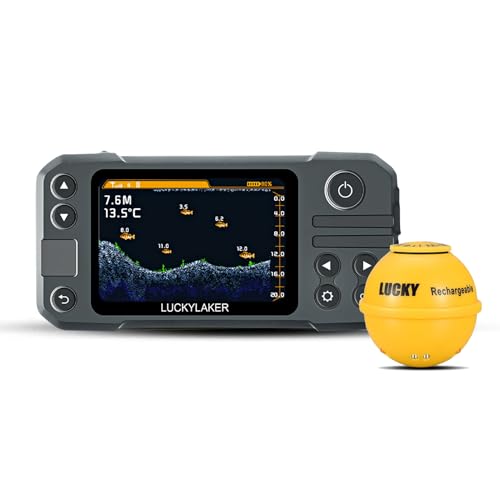
The MT-202 offers wireless operation with a long sensor range, designed for boats, kayaks, or shore fishing. It highlights a substantial 853-foot operation distance and a 90-degree beam for a broad underwater view. It’s ideal for anglers who want a wire-free setup and simple depth and location readouts. Best for those who value range and ease of use over ultra-detailed imaging. A caveat is that wireless systems can occasionally require sensor recalibration after rough moves or strong waves.
Venterior Portable Rechargeable Fish Finder

The Venterior model is a compact, wireless sonar option with a castable sensor. It measures depth, temperature, fish size, and bottom contours, making it versatile for ponds, lakes, and shoreline outings. It supports a dual-mode operation (Work and Simulation) and allows unit-to-sensor distance up to about 262 feet. It’s best for budget-conscious anglers who want a color display and simple data in one handheld device. A limitation is that the user must manage battery life carefully for longer sessions.
LUCKY Kayak Portable Fish Depth Finder (FFC1108)

This handheld unit displays fish depth and water depth with weed and bottom contour readings. It uses a 45-degree beam at 200 kHz and includes a neck strap for hands-free operation while paddling. It’s best for kayakers who want quick, readable data and a lightweight profile. A potential limitation is that the display is smaller, which can make detailed interpretation slower in bright sunlight or choppy conditions.
Humminbird PiranhaMAX 4 Fish Finder

The Humminbird PiranhaMAX 4 provides dual-beam sonar and a straightforward interface. It’s a compact option suitable for kayak setups, offering dependable depth and fish-structure readings. Best for anglers who want a reliable, established brand with simple controls. A consideration is that this model is not the lightest portable option in the list, and setup may require basic mounting on small vessels.
Garmin Striker 4 with Transducer

The Garmin Striker 4 offers a crisp 3.5-inch color display with CHIRP scanning sonar for enhanced target clarity. It includes a built-in GPS and a simple interface suitable for kayak use, plus a durable IPX7 rating for water exposure. Best for anglers who want precise imaging, easy waypoint navigation, and a compact screen. The device is a bit more feature-rich than some ultra-budget options, so it may be overkill for casual, occasional kayak fishing.
Buying Guide: Portable Kayak Fish Finder Essentials
What should I consider when choosing a portable kayak fish finder?
Key factors include source of power (rechargeable vs. disposable batteries), water type (freshwater vs. saltwater tolerance), display readability in sunlight, and the data you need most (depth, fish location, bottom contour). A compact, neck-worn model is ideal for busy paddling, while a wireless sensor can reduce clutter on smaller boats.
Wired vs. Wireless: Which is better for kayaks?
Wired units typically offer stable power and straightforward setup, suitable for stationary or slow-movement paddling. Wireless designs provide freedom from cables, making them better for moving kayaks or multi-boat use. Consider range, sensor durability, and battery life when choosing.
How important is beam angle and frequency?
A wider beam angle (e.g., 90 degrees) covers more water and helps locate fish and structures quickly, while a narrower beam (e.g., 45 degrees) provides more detailed readings at depth. Frequency selections (e.g., 200 kHz) influence depth range and clarity, particularly in water conditions with weed or bottom variations.
Battery life and portability considerations
Battery life determines how long you can fish without recharging. If you kayak for several hours, prefer devices that use widely available batteries or come with rechargeables. For longer trips, a model supporting external power options can be advantageous.
Display readability and durability
Look for high-contrast screens with backlighting for bright sunlight and quick readability. Durability, IP ratings, and water-resistance are important for kayak environments where splashes and rain are common.
Bottom line: choose with your primary use in mind
If you mostly paddle at calm lakes, a compact wired model with straightforward depth and fish indicators may suffice. If you frequently fish from moving kayaks or beaches, a wireless, long-range option can be more convenient. For ongoing navigation and structure mapping, a color display paired with CHIRP-like sonar offers deeper insight.
Frequently Asked Questions
- What is the best portable fish finder for kayak fishing? The best choice depends on your priorities: portability, range, and whether you prefer wired or wireless sensors. Models like Yoocylii and LUCKY MT-202 are strong starting points for compact, kayak-friendly use.
- Do portable fish finders work in saltwater? Yes, many portable units operate in both fresh and saltwater. Check the manufacturer notes for corrosion resistance and sensor compatibility to ensure durability in saline environments.
- Can I use these while moving on a kayak? Yes, several units support use on moving kayaks with careful speed control and proper sensor orientation. Some units advise keeping speed below certain mph for accurate readings.
- How long do batteries last on a typical handheld finder? Battery life varies by model, but many provide several hours of continuous use with disposable or rechargeable options. Always carry spare batteries if you plan longer trips.
- Is a larger display always better for kayak fishing? Not necessarily. A larger display improves readability, but portability and weight matter more for a kayak setup. Choose a screen size that balances legibility with handling ease on the water.
- Do I need GPS on a kayak fish finder? GPS helps mark waypoints and navigate back to productive spots. If you want mapping features, select a model that explicitly includes waypoint navigation and map support.