Answering the need for humane, chemical-free yard protection, motion activated sprinkler animal repellents deter common garden pests by delivering a sudden water spray when animals approach. This guide compares top options ideal for different property sizes and wildlife challenges. The best picks suit homeowners with lawns, gardens, or courtyards who prefer eco-friendly deterrents, easy setup, and adjustable coverage. Below is a quick summary of five strong contenders, followed by in-depth product insights.
| Product | Best For | Key Strength | Limitations |
|---|---|---|---|
| Orbit Yard Enforcer | Medium lawns, mixed wildlife | Multi-angle detection, dual-purpose spray | Wired power option required for full features |
| Havahart Critter Ridder 5277 | Quiet neighborhoods, varied pests | Infrared 60-ft range, eco-friendly water use | Requires batteries (not included) |
| Peepst Solar Animal Sprinkler | Sunlit yards, solar-powered setup | 360° nozzle, flashing lights, long runtime | Solar dependent for continuous operation |
| G-Jyuncyou Motion-Activated Sprinkler (Solar) | Rural or large yards | 8m PIR range, 4-level sensitivity | Requires proper setup to avoid false positives |
| TRURID Motion Activated Sprinklers | Budget-conscious homes | Rotating sprinkler with wide coverage | May require more frequent maintenance |
Orbit Yard Enforcer Motion-Activated Sprinkler

The Orbit Yard Enforcer uses motion detection to deter animals from gardens and lawns. It delivers bursts of water to create a humane deterrent without chemicals. The device offers wide, multi-angle detection and infrared accuracy for reliable activation. Settings allow adjusting spray duration and a timed watering option, enabling the unit to function as a dual-purpose sprinkler. Best for homeowners with medium-sized lawns and mixed pest concerns who want flexible spray control.
Who it’s best for: Homeowners who value a robust, sensor-driven deterrent with adaptable spray timing. Why selected: It combines broad coverage with user-adjustable features to tailor protection. Caution: For full feature access, ensure proper power setup and consider weatherproof placement to avoid false activations in windy conditions.
Havahart Critter Ridder 5277

The Havahart Critter Ridder 5277 uses infrared sensing to detect heat and movement up to 60 feet away, triggering a safe water spray. It targets a broad range of pests, including cats, dogs, raccoons, and deer, with a humane approach that relies on a brief spray. It’s an eco-friendly choice due to low water consumption per activation. Best for yards where humane deterrence is prioritized and where pests come from predictable routes.
Who it’s best for: Homeowners seeking a proven, chemical-free solution for mixed pests. Why selected: The extended infrared range and low water usage support dependable deterrence. Caution: Batteries are required but not included, so plan for replacement or compatible power options.
Peepst Solar Animal Sprinkler
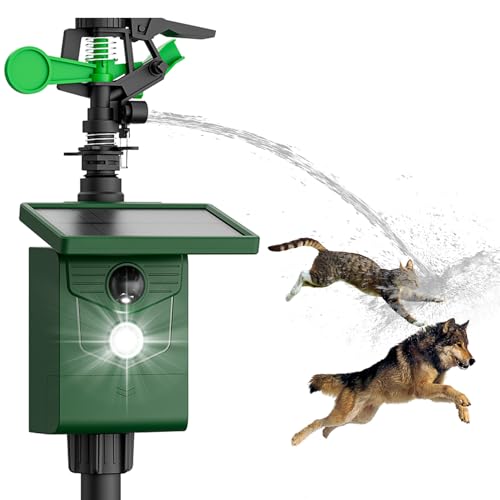
This solar-powered cat repeller combines water spray with flashing strobe lights for deterrence. Its 110° PIR sensor covers up to 26 feet, and a 360° rotatable nozzle lets users adjust spray angle, distance, and flow from concentrated streams to dispersed mist. It supports both solar and DC charging, offering flexibility for areas with varying sun exposure. Best for sunlit yards where a long-running, low-maintenance deterrent is desired.
Who it’s best for: Gardeners needing flexible spray and lighting cues in a solar-powered system. Why selected: The dual charging and adjustable nozzle provide adaptable coverage. Caution: Solar performance depends on sun exposure; consider a backup DC charging option for reliability in cloudy periods.
G-Jyuncyou 2 Packs Motion Activated Deer Repellent

This two-pack from G-Jyuncyou features PIR sensors with four sensitivity levels, enabling customized detection up to 26 feet. Each unit sprays water with a flashing light when motion is detected. The nozzle is adjustable for 360° rotation or fixed angles, with a spray range up to six meters depending on water pressure. Best for larger yards or multiple entry points that benefit from flexible, programmable deterrence.
Who it’s best for: Households needing scalable deterrence across several zones. Why selected: Dual-pack design expands coverage while maintaining a consistent deterrent approach. Caution: Performance depends on proper installation to minimize false alarms and ensure reliable detection in windy areas.
G-Jyuncyou Solar Motion-Activated Sprinkler

This solar animal repellent combines a motion-activated spray with flashing lights and a PIR sensor that reaches up to 8 meters (26 feet) at a 110° angle. It features a four-level sensitivity knob, allowing environment-tailored detection. Easy installation with a durable IP65-rated waterproof housing. Best for yards that need a compact, weatherproof deterrent with simple setup.
Who it’s best for: Homeowners seeking a compact, solar-powered deterrent with adjustable sensitivity. Why selected: The IP65 rating and simple install support reliable outdoor use. Caution: Like other solar devices, performance relies on sun exposure for best uptime.
Buying Guide: How To Choose The Right Motion Activated Sprinkler
What wildlife are you most concerned about? Different devices target deer, raccoons, cats, and dogs with varying spray ranges and sensor sensitivities. For multi-pest properties, consider units with broad detection zones and adjustable spray patterns.
Power source matters. Some units are solar-powered with back-up charging, others require a power source or batteries. If your yard has limited sun or frequent overcast days, a model with a backup charging option or wired power may provide more reliable performance.
Detection range and spray control are key. Look for infrared sensors rated by distance, angle, and a multi-angle detection capability. A rotatable nozzle and adjustable spray force help tailor coverage to lawn size and plant beds. If you want to minimize watering, choose models with shorter spray durations or eco-friendly water use.
Ease of installation and maintenance. Durable housings, IP ratings for weatherproofing, and simple nozzle adjustments simplify long-term use. Consider whether you’ll need multiple units to cover larger properties and if a multi-pack option provides better value.
Safety and humane deterrence. All models use water to deter animals; ensure they operate without harming wildlife and are suitable for your local regulations and yard layout. Look for models that pause or limit activations during heavy rain to avoid wasteful spraying.
Feature trade-offs. Solar options reduce wiring needs but depend on sun. Battery-powered units offer flexibility but require replacements. Some offer flashing lights for additional deterrence; others emphasize longer sensor range. Align features with your yard’s layout and wildlife challenges.
Frequently Asked Questions
- Do motion activated sprinklers actually deter all pests? They deter many common yard pests but effectiveness varies by pest and environment. For best results, place devices along known animal routes and ensure regular maintenance.
- Can these devices scare away wildlife permanently? They are designed for humane deterrence, teaching animals to avoid treated areas. They are not guaranteed to permanently remove pests.
- How much water do these devices use? Water usage is generally modest per activation, but exact amounts depend on spray duration and nozzle settings. Some models emphasize eco-friendly operation.
- Are solar-powered sprinklers reliable year-round? Solar units work well in sunny seasons, but back-up charging or alternative power may help in low-light periods or winter months.
- Is multi-pack coverage worth it for large yards? Yes, a multi-pack can provide comprehensive coverage across larger properties or multiple entry points, often at better per-unit value.
- What maintenance is needed? Regularly clean nozzles, check battery or solar charging, inspect wiring (for wired models), and verify sensor alignment after weather events or lawn care.