When you need reliable options for 10X, 40X, and 100X magnifications, this guide highlights five practical choices. These models suit science students, hobbyists, and educators seeking compatible objectives, sturdy stands, and clear optics. Each product listing explains who benefits most and why it’s recommended, along with a realistic caveat to consider before you buy.
Quick overview of selected products:
| Product | Best For | Why It Stands Out | Limitations |
|---|---|---|---|
| hokojix Upgraded Microscope | Beginners to mid-level users | 3 magnifications (10X/40X/100X) with RMS thread for compatibility | Basic stand and optics may not suit high-end labs |
| AmScope A100X (Oil) Objective | Advanced beginners to hobbyists | 100X oil objective with high NA for sharp images | Requires oil immersion technique |
| AmScope A40X 40X Objective | Home labs and classrooms | DIN/JIS standard 40X objective; good for entry-level users | Spring mechanism may be less rigid for avid pros |
| ZOVVTRON Monocular Microscope | Students and educators | Broad 100X–2000X range with multiple illumination options | Plastic frame may limit durability |
| PALOBIL Microscope Kit | Kids and adults learning basics | Multiple magnifications up to 2000X with included slides | Non-professional grade; may require careful handling |
hokojix Upgraded Microscope 10X 40X 100X

The hokojix model offers a 3-magnification set (10X, 40X, 100X) with an achromatic objective and a standard RMS mounting size of 20.2 mm. It is best for hobbyists who want a straightforward setup that covers common classroom and home-use needs without specialized equipment. The achromatic objective reduces chromatic aberration, helping deliver crisper images at each magnification. A limitation to consider is that this unit uses a basic stand, which may be less stable for very fine focusing compared with higher-end systems. Suitable for students and entry-level researchers who need a compact, versatile starter microscope.
AmScope A100X 100X (Oil) Achromatic Objective
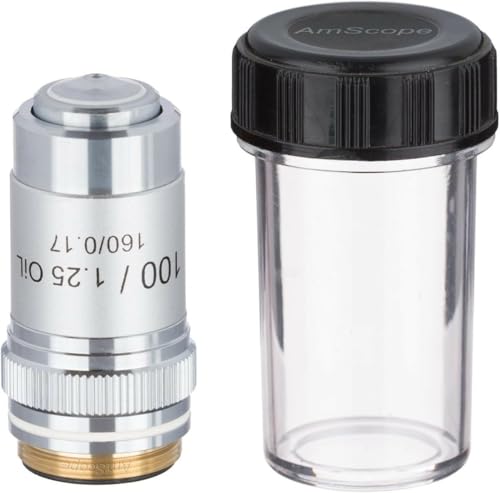
The AmScope A100X provides a dedicated 100X oil-immersion objective with achromatic correction for sharp, true-color imaging. Its high numerical aperture (NA 1.25) improves light gathering and resolution. It’s designed for 160 mm mechanical tube length and 45 mm parfocal distance, promoting precise optical alignment. Best for intermediate users who need higher-detail imaging, such as examining small cellular structures or detailed specimens. A potential limitation is the oil immersion requirement, which adds handling steps and post-use cleanup compared to dry objectives.
AmScope A40X 40X (Spring) Objective

The AmScope A40X 40X objective is a spring-loaded achromatic lens designed for standard DIN/JIS microscopes. It delivers reliable 40X magnification with a spring mechanism to help protect the lenses from damage during focusing. This makes it a solid choice for classrooms or home labs where robust, user-friendly optics are valued. Better for learners who want a straightforward 40X option in a complete kit, but not the best pick if users require premium oil-immersion capabilities or ultra-high NA for advanced research.
ZOVVTRON Monocular Biological Microscope

The ZOVVTRON monocular microscope covers 100X to 2000X magnification with WF25X eyepiece and 4X/10X/40X/100X objectives. It includes dual LED illumination with adjustable brightness, plus a durable yet lightweight frame. This makes it well-suited for adults, students, and classroom use where a broad range of observation scales is valuable. A caution: build quality is adequate for education and light lab tasks, but heavy professional use may require a more rigid frame and more precise optical alignment.
PALOBIL Microscope Kit For All Ages

The PALOBIL kit targets both kids and adults with a broad range of magnifications and include prepared slides and covers. It supports 100X to 2000X observations via a WF25X eyepiece and multiple objective lenses, enabling a hands-on learning experience. Best for homeschoolers, early learners, or households building basic microscopy skills. Limitation: while versatile, it may lack some refinements found in higher-end research-grade systems, and certain accessories may be basic.
Buying Guide
What should you consider when choosing a microscope for 10X, 40X and 100X work?
- Magnification range and objectives: Look for objectives that cover 10X, 40X, and 100X, and verify if 100X is oil-immersion or dry. Oil immersion offers better resolution but requires more maintenance.
- Optical quality: Achromatic objectives reduce color fringing but may not match plan or semi-plan objectives. For many educational uses, achromatic is adequate; plan objectives help with edge-to-edge sharpness.
- Illumination: LED illumination is common and reliable. Adjustable brightness helps with translucent and opaque samples. Dual illumination (top and bottom) expands observation options.
- Mechanical stability: A sturdy stage and solid focusing mechanism improve repeatability, especially at higher magnifications where tiny focus changes matter.
- Ease of use: Spring-loaded 40X objectives protect lenses during mounting. Oil-immersion requires careful handling and cleaning routines.
- Compatibility: RMS receptor compatibility (for objective lenses) ensures you can swap lenses between compatible stands.
- Skill level: Beginners benefit from kits with included slides and straightforward guiding features, while educators may prefer more durable classroom-grade units.
How to compare products quickly
- Best for beginner users: hokojix Upgraded Microscope challenges with essential 10X, 40X, and 100X options in a single assembly.
- Better for high-detail imaging: AmScope A100X with 100X oil objective and high NA suits precise cellular work.
- Choose this if you need reliable 40X performance: AmScope A40X 40X objective provides a solid balance of adaptability and optical quality.
- Best for broad magnification range in education: ZOVVTRON Monocular offers a wide 100X–2000X span with adjustable illumination.
- Best value for growing interest: PALOBIL kit gives diverse magnifications and teaching aids for families and classrooms.
Frequently Asked Questions
- What magnification should I start with for learning biology? – A 40X objective is a practical starting point for observing cells and tissues, complemented by 10X and 100X as needed.
- Is oil immersion necessary for 100X? – It is common for high-detail 100X observation; it requires oil and extra cleaning steps.
- Are educational kits as good as professional setups? – They are ideal for learning and basic experiments but may lack advanced optics for professional research.
- Can I upgrade lenses later? – Yes, most systems support interchangeable objectives; check RMS compatibility and tube length before upgrading.
- Do I need dual illumination? – Dual lighting helps with both translucent specimens and opaque samples, improving contrast in many scenarios.
- Is a sturdy frame important for high magnifications? – Yes, a rigid frame and stable focusing make high-magnification work more reliable.