Find the right gas radiant garage heater for reliable warmth in workshops, barns, and large garages. This guide highlights five top options, explaining who they’re best for, how they heat, and practical pros and cons. Radiant and vent-free models heat objects and people directly, making them ideal for well-insulated spaces or where quick warmth is needed. If you need ceiling-mounted warmth or room-wide heating, we’ve included a forced-air option as well. Read on to compare features, fuel options, and suitability for different garage sizes and layouts.
| Product | Best For | BTU / Heating Area | Fuel |
|---|---|---|---|
| Mr. Heater F272800 40,000 BTU Natural Gas Garage Heater | Mid-size garages with radiant needs | 40,000 BTU | Natural Gas |
| Mr. Heater 50,000 BTU Forced-Air Unit Heater | Large spaces needing even air distribution | 50,000 BTU | Propane or Natural Gas |
| Mr. Heater 30,000 BTU Vent Free Radiant Natural Gas Heater | Smaller to mid-size spaces, quick radiant heat | 30,000 BTU | Natural Gas |
| Mr. Heater 30,000 BTU Vent Free Blue Flame Natural Gas Heater | Budget-friendly radiant heat with blue flame efficiency | 30,000 BTU | Natural Gas |
| ProCom Dual Fuel Ventless Blue Flame Garage Heater – 30,000 BTU | Flex fuel capability and versatile installation | 30,000 BTU | Propane or Natural Gas |
Mr. Heater F272800 40,000 BTU Natural Gas Garage Heater

Best for: Medium garages that need efficient infrared warmth. This radiant heater provides 40,000 BTU and is designed for spaces with ceilings around 12–15 feet. It is a natural gas unit that concentrates heat where you stand, reducing wasted air movement.
Why selected: A purpose-built infrared option that prioritizes efficiency and cost per hour of operation. Clearances are noted for safe installation with the top clearance at 36 inches and sides/back at 30 inches.
Caution: Suitable for spaces with proper venting and compliance; ensure correct mounting and clearances before installation. Avoid placing directly over flammable materials within spec zones.
Mr. Heater 50,000 BTU Forced-Air Unit Heater

Best for: Large garages or barns needing uniform air distribution. This ceiling-mounted unit delivers 50,000 BTU and can heat spaces up to about 1,667 sq ft. It can be paired with standard thermostats (sold separately) for automated control.
Why selected: A robust forced-air option that complements radiant heaters by circulating heated air for evenly warmed environments.
Caution: Forced-air designs require proper ducting considerations and alignment with electrical/thermostat compatibility; ensure clearances and ventilation meet local codes.
Mr. Heater 30,000 BTU Vent Free Radiant Natural Gas Heater

Best for: Small to mid-sized spaces where immediate radiant warmth is desired without venting. Heats up to about 1,000 square feet, making it suitable for workshops and garages offering fast heat on demand.
Why selected: Vent-free design means no exterior venting is required, increasing installation flexibility in tight spaces.
Caution: Vent-free units rely on accurate fuel and air balance; ensure proper clearance and room size for safe operation.
Mr. Heater 30,000 BTU Vent Free Blue Flame Natural Gas Heater

Best for: Budget-conscious buyers seeking higher efficiency with blue flame heat. Heats up to 1,000 square feet and includes a battery-operated electronic ignition.
Why selected: Blue flame models often provide efficient radiant heat with modern ignition, suitable for continuous use in well-ventilated spaces.
Caution: Vent-free units still require adequate room volume and proper gas connections; consider fuel type and room layout before purchase.
ProCom Dual Fuel Ventless Blue Flame Garage Heater – 30,000 BTU
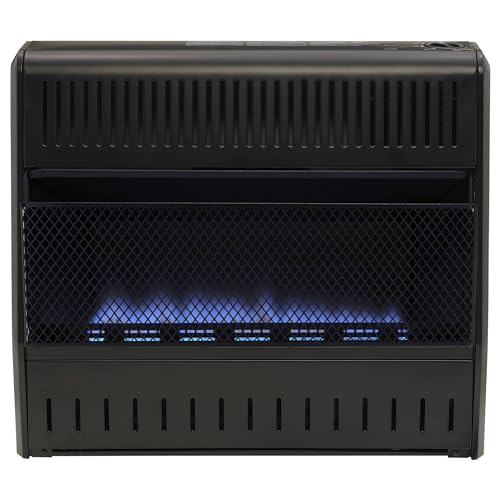
Best for: Flexible fuel options in garages where natural gas or propane is possible. This dual-fuel heater operates at 30,000 BTU and features thermostatic control with variable settings.
Why selected: Dual-fuel capability expands installation options, and ventless operation simplifies setup in spaces without venting infrastructure.
Caution: Ensure proper burner efficiency and local code compliance when using dual-fuel configurations; monitor ventilation and combustion safety.
Buying Guide
What to consider when choosing a gas garage heater:
- Heat source and fuel type: Natural gas is common for vented, ventless, and radiant units. Propane is a viable alternative in some models. Consider fuel availability and cost in your area.
- Heating method: Radiant/vent-free heaters warm people and objects directly, while forced-air units distribute warm air for larger spaces. A combination approach can optimize comfort.
- Space size and ceiling height: Larger spaces may require higher BTUs or multiple units. Ceilings around 8–12 feet behave differently from those at 12–15 feet or higher.
- Ventilation and code compliance: Vent-free heaters require adequate room volume and proper clearance. Vented models rely on exhaust pathways and may need installation permits.
- Installation considerations: Clearances, mounting options (ceiling-mounted vs. floor/standalone), and thermostat compatibility affect performance and safety.
- Ignition and control: Look for electronic ignition efficiency, manual or thermostat control, and compatibility with existing thermostats or smart controls.
FAQ
What heater BTU should I choose for a 300–700 sq ft garage?
For 300–700 sq ft, 20,000–40,000 BTU options are common, depending on insulation and climate. Radiant, vent-free models can heat quickly, while forced-air units provide even distribution for larger spaces.
Is a vent-free heater safe for a garage?
Vent-free heaters are designed for enclosed spaces with proper clearance and ventilation. Follow the manufacturer’s clearances and local codes to ensure safety.
Can I install a gas heater without professional help?
Gas installations typically require licensed professional assistance to ensure safe fuel supply, venting (if needed), and electrical connections.
How do I choose between radiant and forced-air heater?
Choose radiant for fast direct warmth and energy efficiency in smaller spaces. Choose forced-air for larger spaces or when you want even air distribution.
Do dual-fuel heaters offer real advantages?
Dual-fuel heaters provide flexibility by allowing natural gas or propane. They can be advantageous where one fuel type is more accessible or economical.