Looking for an energy efficient window air conditioner that fits your space and keeps bills down? This guide highlights five compact, budget-friendly options ideal for bedrooms, small living rooms, and home offices. Read on to see which model is best for you, plus a practical buying guide and common questions answered.
| Product | Best For | Key Benefit |
|---|---|---|
| Frigidaire 5,000 BTU Window A/C | Small spaces up to 150 sq ft | Quiet operation with two fan speeds |
| Midea 5,000 BTU EasyCool | Budget-friendly small rooms | High CEER and reusable filter |
| Amazon Basics 5,000 BTU Window A/C | Simple, no-frills cooling | Seven temperature settings and two modes |
| TCL 5,000 BTU Window A/C | Compact, energy-conscious spaces | Ceering CEER 11.0 and four-way vent |
| GE 5,000 BTU Window A/C | Small rooms needing reliable controls | Two cooling modes with simple mechanical controls |
Frigidaire 5,000 BTU Window A/C — Quiet, Efficient, Easy to Use

Best for: Bedrooms or small living spaces where quiet operation matters. This Frigidaire model offers two fan speeds and adjustable temperature control for consistent comfort. It’s suitable for users who want straightforward use without smart features.
- Effortless Cooling with two fan speeds and precise temperature control.
- Washable filter for easy maintenance and dust capture.
- Quiet performance at 52 dBA, ideal for bedrooms or small rooms up to 150 sq ft.
Caution: Basic mechanical controls mean no remote, so adjust settings manually. If you need smart features, consider a different model.
Midea 5,000 BTU EasyCool Window A/C
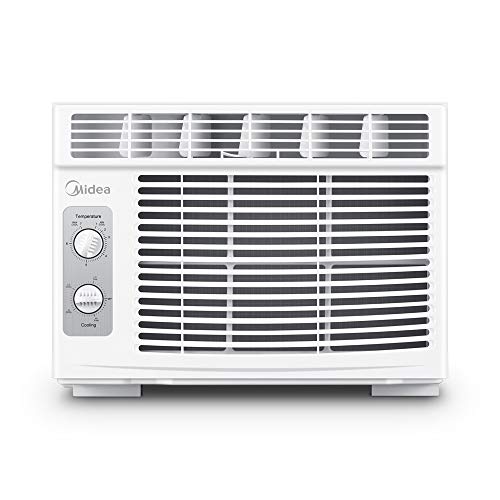
Best for: Budget-conscious shoppers who want reliable cooling in small rooms. Midea’s unit combines solid cooling with an easy-to-use mechanical interface and a reusable filter.
- Perfect for rooms up to 150 sq ft with 7 temperature settings.
- CEER 11.0 supports energy cost savings over time.
- Two cooling/fan speeds and 2-way air direction for tailored comfort.
Caution: Mechanical controls are not app-enabled; fewer smart features may be a downside for tech-focused users.
Amazon Basics 5,000-BTU Window A/C

Best for: Quick, no-fuss cooling for small offices or bedrooms. The unit pairs easy maintenance with flexible cooling options and straightforward settings.
- 5000 BTU capacity suitable for rooms up to 150 sq ft.
- Two-in-one cooling and fan modes with washable filter.
- Seven temperature settings and two-speed operation for personalized comfort.
Limitation: While simple to operate, it lacks smart control features found in higher-end models.
TCL 5,000 BTU Window A/C With 4-Way Vent
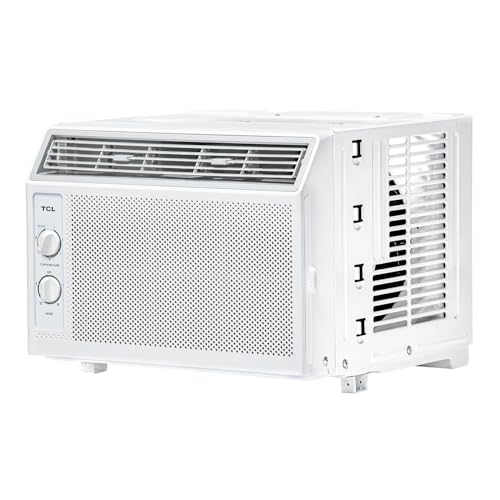
Best for: Small rooms needing flexible airflow. TCL emphasizes energy efficiency and adjustable airflow to hit comfort targets.
- CEER 11.0 for energy cost savings across seasons.
- Four-way directional vent helps direct airflow precisely where needed.
- Compact design suitable for tight window fitments in apartments or dorms.
Caution: Some users may prefer models with digital controls for advanced programming.
GE Window A/C — Simple Controls, Reliable Performance

Best for: Small rooms requiring dependable two-mode cooling with basic mechanical controls. GE’s unit is known for straightforward operation and solid cooling power.
- Two cooling modes and simple dials for quick setup.
- Auto restart after power outages for continuous comfort.
- Compact footprint fits tight spaces in bedrooms, offices, and studios.
Caution: No Wi-Fi or smart features; may not suit tech-driven homes seeking app control.
Buying Guide: What To Consider When Choosing
Room size remains the dominant factor in selecting a window air conditioner. For spaces up to 150 sq ft, a 5,000 BTU unit is typically sufficient, while CEER and energy saving features influence long-term operating costs.
- Energy efficiency: Look for CEER ratings around 11.0 or higher for better cost savings over time.
- Controls: Decide between mechanical knobs and digital remotes or smart features. Remote access adds convenience but may increase cost.
- Noise level: If the unit sits in a bedroom, prioritize models with lower dBA ratings (generally below 55 dBA).
- Airflow direction: Four-way vents or adjustable louvers help target drafts and improve comfort distribution.
- Maintenance: Washable or reusable filters simplify upkeep and maintain indoor air quality.
- Installation: Ensure the included kit fits your window width and that installation won’t interfere with window operation.
Which style fits your space?
- Basic, quiet cooling: Frigidaire 5,000 BTU or GE 5,000 BTU cover straightforward needs with minimal setup.
- Budget-friendly ease: Midea and Amazon Basics provide reliable cooling with reusable filters and simple controls.
- Airflow flexibility: TCL and Frigidaire 6,000 BTU variants offer enhanced venting features for uneven rooms.
Smart features worth considering
Smart-enabled units offer remote control, scheduling, and voice assistant compatibility. If you value remote management or integration with home automation, look for models marketed as Wi-Fi-enabled or SmartHome-compatible. For many buyers, simple mechanical controls paired with energy efficiency provide the best balance of cost and performance.
Short FAQ
- What size window A/C do I need for a 150 sq ft room? Best practice is a 5,000 BTU unit for spaces up to 150 sq ft.
- Are CEER ratings important? Yes. Higher CEER means better energy efficiency and potential savings over time.
- Do I need a smart thermostat to use a window A/C? No. Many units offer essential manual controls; smart features are optional.
- Can these units cool more than one room? They are designed for single-room use; for multiple rooms, consider a portable unit or a central system.
- Is noise a concern with window units? Yes, particularly in bedrooms. Look for models with low dBA ratings.
- What maintenance helps longevity? Regularly clean or replace washable filters and keep intake vents clear of dust.
This article lists five energy-efficient 5,000 BTU window air conditioners suitable for small rooms, with practical buying guidance and straightforward comparisons to help shoppers select the best model for their needs.