Answering the question “which door lock code system is best?” this guide compares five top keypad and WiFi-enabled door locks. Each model supports multiple user codes, temporary guest access, and auto-locking features. This article helps buyers choose by use case: for busy households, rentals, or tech-forward homes. The selections emphasize reliability, ease of installation, and practical trade-offs like hub requirements and remote access. A quick comparison table below highlights the core capabilities to assist decision-making.
| Product | Best For | Key Features |
|---|---|---|
| Families needing flexible codes | 20 codes, temporary one-time code, auto lock, quick 2-second hold for entry | |
| Remote control lovers | Built-in WiFi, app control, voice assistant, real-time access | |
| Budget-friendly, simple installs | Up to 20 codes, auto lock, no app required, backup keys | |
| Durable, flexible entry security | Flex-locking, multiple codes, tamper resistance | |
| Easy DIY installs | 20 codes, 2 keys, one-time codes, weather resistant |
TEEHO TE001 Keyless Entry Door Lock with Keypad

Best for multi-user households needing flexible access codes. The TE001 offers 20 programmable codes plus a one-time code for guests, plus an auto-lock option and a quick 2-second keypad hold to lock. The installation is described as easy, making it suitable for front doors and rental properties where temporary access is common. The 10–99 second auto-lock window can be tuned to daily routines or left off for high-traffic days. A potential limitation is that it relies on keypad input and may require closer supervision in high-traffic areas with many visitors.
Philips WiFi Keypad Door Lock with Handle
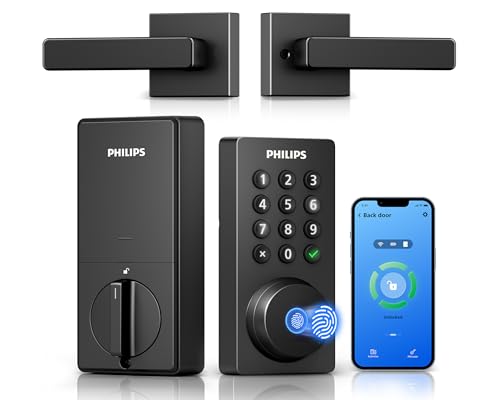
Best for hands-free control and remote access. This lock connects to 2.4GHz WiFi directly, enabling smartphone control, status checks, and real-time access logs via the Philips Home Access App. It supports voice control via Alexa or Google Assistant. A caveat is the need for a stable 2.4GHz network and a hub-less setup, which is ideal for smart home ecosystems but may lag in weak WiFi areas.
Keypad Door Lock with Handle: NICE DIGI

Best for simple installs and no app dependency. NICE DIGI offers up to 20 codes, temporary one-time codes, and two backup keys. Auto lock can be set between 5 and 99 seconds, or the lock can remain in passage mode during busy hours. The key advantage is not requiring WiFi or an app, which is ideal for renters or those who prefer minimal smart-home integration. A limitation is the lack of remote monitoring or control without added hardware.
Schlage Camelot Keypad Lock with Lever Handle

Best for durable, flexible residential security. The Camelot integrates keyless entry with the lever handle and a flexible locking option. It supports up to 19 codes beyond two pre-programmed ones, allowing convenient access for trusted friends and family. The design emphasizes reliability and a robust metal build. A potential drawback is that some users may prefer more modern smart features like remote unlocking, which this model does not inherently provide without extra hardware.
Schlage Plymouth Keypad Lock with Lever Handle

Best for auto-locking convenience with a familiar lever design. The Plymouth model offers keyless entry, auto-lock after five seconds, and an illuminated keypad for night access. It provides a straightforward safety layer and is easy to install. The limitation is the inside lever is always unlocked by design, so users should rely on the keypad for actual security during non-occupancy periods. Ideal for homes prioritizing quick entry and clear, simple operation.
Yamiry Keypad Smart Door Knob Lock

Best for quick DIY installations with a knob-based approach. Yamiry offers 20 codes and two physical keys, plus one-time codes for guests. The lock supports a backlit keypad with a weather-resistant build (IP54) and a low battery indicator. It is well-suited for homeowners who want an easy install that does not require professional assistance. A caution is that knob-style locks may be less secure than deadbolt-based designs in heavy-use scenarios.
Buying Guide
What type of entry system fits your home? Choose keypad-only if you want a simple, no-app option, or WiFi-enabled locks if remote control and monitoring matter. Do you need temporary codes for guests or rentals? Look for models offering one-time codes and time-based auto-locking. How easy is installation? Some units require only a screwdriver, while others may benefit from professional installation, especially if a door’s alignment is unusual. Do you need voice control or smart-home integration? Consider platforms supported (Alexa, Google Assistant) and whether a dedicated app provides real-time access logs. Battery life and network reliability also affect daily use; plan for backup access options like physical keys where available.
FAQ
- Which door lock code system is easiest to install? Models labeled as “easy installation” typically require minimal tools and no drilling beyond standard latch installation.
- Can I grant temporary access to guests? Yes. Look for locks offering one-time codes or time-limited access to manage guest visits smoothly.
- Do these locks require a hub for smart features? Some do not; WiFi-enabled units connect directly to your home network, while others may need a hub for remote features.
- Is it safer to choose a deadbolt or a lever handle? Deadbolts generally provide stronger security; lever handles are convenient but should accompany a solid lock mechanism.
- Will I still be able to use a keypad if the WiFi is down? Keypad functionality often remains independent of network status, but some smart features may be unavailable without connectivity.
- What should I consider for rental properties? Prioritize codes management, temporary access, and durable hardware suitable for frequent entry and exit.