Choosing a dog wireless containment system helps keep pets secure while preserving yard aesthetics and outdoor freedom. This guide focuses on reliable, easy-to-setup options suitable for American households with various training needs. Top picks are best for: casual dogs who need simple setup, stubborn or large dogs requiring stronger guidance, multi-dog households, and travelers seeking portable solutions.
Summary table of selected products:
| Product | Best For | Key Benefit | Limitations |
|---|---|---|---|
| PetSafe Original Wireless Fence | Travel-ready households | Portable, covers up to 1/2 acre | Limited boundary size without extra transmitters |
| PetSafe Stay & Play Wireless Fence | Persistent, training-heavy dogs | Circular boundary up to 3/4 acre | Requires training to optimize tone and static levels |
| PetSafe Wireless Containment for 2 Dogs | Two-dog households | Includes two collars, 1/2 acre coverage | May require careful boundary setup for both dogs |
| MIMOFPET Wireless Fence for 2 Dogs | Flexible range and training modes | Wide range, multiple training modes | New system, may require a learning curve |
| PetSafe Guardian GPS Fence | Large yards with GPS tracking | GPS-based, no subscription | More tech-dependent; not purely traditional boundary |
PetSafe Original Wireless Electric Fence for Dogs

Best for: Travelers and pet owners who want a simple, portable wireless boundary. This system covers up to 1/2 acre and is ideal for indoor-to-outdoor use without buried wires.
Why selected: It uses a portable indoor transmitter with a fixed circular boundary that gently guides your dog back to the play area. Cut setup time significantly since there is no digging or wiring to bury.
Tips: Choose this if you need a lightweight, travel-friendly solution. A potential limitation is boundary size; for larger yards, additional transmitters are required, which adds cost and setup steps.
PetSafe Stay & Play Wireless Pet Fence

Best for: Dogs that are persistent or harder to train, needing adjustable tone and static settings. It supports a larger circular boundary up to 3/4 acre from an indoor transmitter.
Why selected: With a tone-only mode and five static levels, this system adapts to individual dog responses during training. It’s well-suited for households prioritizing gradual behavior shaping.
Tips: Best used with consistent training sessions. A limitation to watch is the need to fine-tune the levels for each dog to minimize false corrections.
PetSafe Wireless Containment Fence for 2 Dogs
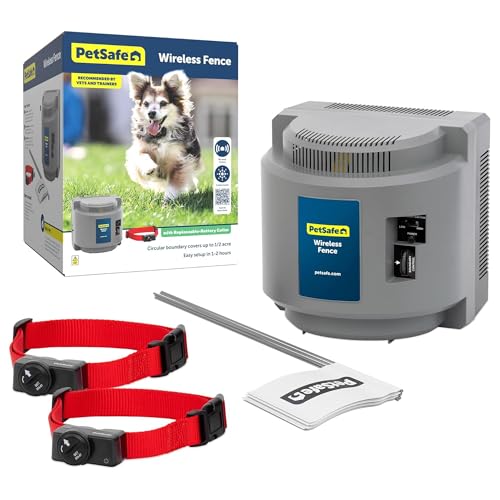
Best for: Multi-pet households seeking a ready two-collar setup. It provides 1/2 acre of circular coverage and is expandable with an additional transmitter.
Why selected: The package includes two collars and boundary flags to quickly begin training, reducing setup friction for two dogs. A limitation is that performance depends on consistent use across both pets and proper boundary placement.
Tips: Choose this if you need a two-dog solution without separate systems. Consider additional transmitters for larger or irregular yards.
MIMOFPET Wireless Fence for 2 Dogs

Best for: Pet owners seeking a flexible, tech-forward system with a broad range and training modes. The kit supports two dogs and offers a wide boundary reach from 25 feet to 3500 feet.
Why selected: It combines a wireless boundary with a training remote and multiple modes (Beep, Vibrate, Static) to tailor training to each dog. A potential limitation is the need to learn the system and manage the remote effectively.
Tips: Choose this if you value adjustable range and multi-mode training. Be prepared for a learning curve with the remote and receiver setup.
PetSafe Guardian GPS Dog Fence

Best for: Yard owners seeking GPS-based boundary with subscription-free operation. It supports large properties and offers dynamic protection features without a traditional wire.
Why selected: Guardian GPS combines real-time motion sensing with GPS data for advanced boundary management. It stands out for those who want detailed, scalable boundary control without physical wiring.
Tips: Not ideal if you require a simple, purely radio-frequency fence. The system relies on GPS data and device compatibility, so plan for setup and ongoing use.
Buying Guide: What to Consider Before You Buy
- Boundary size and expandability: Determine whether you need 1/2 acre, 3/4 acre, or multi-dog support, and whether you may need additional transmitters later.
- Training needs: Some systems offer tone-only modes or multiple static levels. Consider your dog’s temperament and your experience with training.
- Portability and installation: If you travel or move homes, a portable system with quick setup is advantageous.
- Multi-dog households: If you have more than one dog, look for kits that include multiple collars or easy scalability.
- Technology type: Radio-frequency wireless systems are common, while GPS-based options offer different advantages and may involve battery considerations and potential subscription features.
- Durability and weather resistance: Look for waterproof collars and rugged transmitters suitable for outdoor use.
- Battery life and maintenance: Long battery life reduces maintenance frequency; check replacement battery compatibility for collars.
Frequently Asked Questions
- What is a wireless dog fence, and how does it work?
A wireless dog fence uses a transmitter to create a circular boundary. When a dog approaches the boundary, a receiver collar emits a warning tone or a mild static correction to guide the dog back inside.
- Can wireless fences work for multiple dogs?
Yes, many kits support two collars or more. Look for multi-dog systems or kits that can be expanded with additional transmitters and collars.
- Are GPS-based fences better than RF wireless fences?
GPS fences offer broader, scalable boundaries and remote monitoring, but require more setup and may involve device compatibility considerations. RF wireless systems are simpler and typically do not require subscriptions.
- What should I consider before choosing a boundary size?
Consider your yard dimensions, dog size, and whether you need room forroaming and play. Larger dogs may require larger radii or stronger correction levels.
- How easy is it to train my dog with these systems?
Training difficulty varies by dog and model. Systems with adjustable tone and static levels allow you to tailor training to your dog’s response, which can speed up the process.
- Do these systems require burying wires?
No. Wireless systems are designed to avoid digging and burying wires, offering a quicker setup and a cleaner yard appearance.