Clear corrugated roofing sheets are ideal for greenhouses, carports, pergolas, and sheds that require bright daylight with reliable protection. This guide highlights five top options designed to be easy to cut, lightweight, and UV resistant. Each product suits different budgets and project needs, from large-scale greenhouse installations to small DIY covers.
The following table summarizes five representative products to help buyers compare at a glance. Use it to quickly identify which sheet set best matches your project size, cutting needs, and climate considerations.
| Product | Best For | Key Advantage |
|---|---|---|
| Tatuo 12 Pack 8′ X 2′ X 0.16” | Larger greenhouse builds | Thick, durable panels with honeycomb insulation |
| HHFSST 8 PCS 3×5.3 ft | Medium to large sunrooms | Excellent drainage and UV protection |
| HHFSST 10 pcs 3×3.2 ft | Smaller areas or modular installs | Good balance of size and coverage |
| 6 PCS Splicable 2.95×5.9 ft | Long runways or sheds | Splicable design for easy joining |
| DHDHSHB 6 pcs 3’x3.2′ | Patio covers and pergolas | Flexible, high light transmission |
Tatuo 12 Pack 8′ X 2′ X 0.16” Polycarbonate Panels

Best for large greenhouse builds and energy efficiency. These panels measure about 2 x 8 ft with a thickness of 0.16 inch, making them sturdy and less prone to breakage. The hollow honeycomb design provides heat insulation, helping to reduce cooling costs in summer and maintain warmth in winter. Both sides offer UV resistance for long-term clarity. They are easy to cut to required sizes with a utility knife.
- Best for: Large greenhouses or multi-panel roof installations
- Why selected: Thick, insulating panels with durable construction and UV protection
- Caution: Handle carefully when cutting to avoid finger injuries; utility knife not included
HHFSST Clear Polycarbonate Roofing Sheet (8 PCS 3×5.3 ft)

Best for sunrooms and greenhouses requiring strong weather resistance and good drainage. Made from high-quality resin and fiberglass, these panels are impact-resistant, flame-retardant, and weather-resistant. The longitudinal grooves promote quick rainwater drainage to prevent leaks. Light transmittance reaches about 85%, balancing bright daylight with UV blocking and thermal insulation for year-round comfort.
- Best for: Greenhouses and sunrooms that experience varied weather
- Why selected: Combines durability with effective drainage and UV protection
- Caution: Ensure precise cutting and joining for seamless installation
HHFSST Clear Polycarbonate Roofing Sheet (10 pcs 3×3.2 ft)

Best for modular configurations and smaller build-outs. This set provides 3×3.2 ft panels that are easy to combine for flexible layouts. The panels maintain good light transmission (around 85%) while offering UV resistance and thermal insulation to support plant growth. Suitable for greenhouses, carports, and pergolas.
- Best for: Modular or smaller projects needing adjustable coverage
- Why selected: Easy to splice and aligns with versatile layouts
- Caution: Verify compatible joining method to avoid gaps
6 PCS Splicable Polycarbonate Roofing Sheets (2.95×5.9 ft)

Best for long runs and extended covers such as sheds or greenhouses. The 2.95×5.9 ft panels are designed for seamless joining, reducing gaps and enabling efficient coverage. Light transmission is strong, and the panels offer UV resistance with a balance of heat retention and cooling. They are easy to cut for custom shapes.
- Best for: Long-span roofing or continuous runs
- Why selected: Splicable design simplifies installation and reduces seams
- Caution: Cutting accuracy matters for tight seals along joints
DHDHSHB Clear Corrugated Plastic Roof Panels (6 pcs 3’x3.2′)
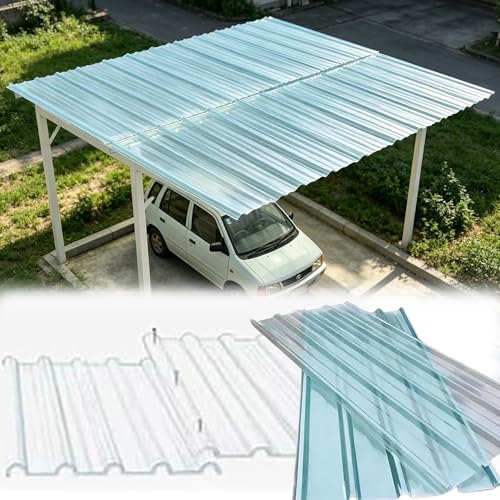
Best for patio covers and pergola styles where a balance of light and protection is needed. These 1mm polycarbonate corrugated panels offer high transparency, enabling daylight while protecting against weather. They interlock through a corrugated design and can be cut to shape without cracking. Light transmission is around 80%, supporting photosynthesis for covered plant areas.
- Best for: Pergolas, patios, and lightweight roof replacements
- Why selected: Flexible, high transparency with easy installation
- Caution: Some users may notice resin powder on unpacking; wipe clean before use
Buying Guide
- What thickness and insulation do I need? Consider panels around 0.16 inch for durability and insulation benefits, especially in temperate or variable climates. Heavier or multi-layer designs can help with heat retention in winter and heat rejection in summer.
- How important is UV protection and light transmission? Look for UV-resistant coatings and transmittance around 80–85% to maximize daylight without excessive glare or yellowing over time.
- Can I splice or join panels easily? Splicable and interlocking corrugated designs reduce seams and simplify installation on long spans, but ensure you have proper cutting tools and alignment for a tight seal.
- What is the best coverage for your roof area? Measure the area carefully and choose panel lengths that minimize waste. Some sets are modular (3×3.2 ft, 3×5.3 ft) while others are long (2×8 ft) for large homes.
- What weather conditions will the roof endure? For exposed areas, select impact-resistant, weather-resistant panels with good drainage to prevent ponding and leakage.
FAQ
- Are corrugated polycarbonate sheets suitable for greenhouses? Yes, they provide good daylight transmission, UV resistance, and insulation for plant growth and energy efficiency.
- Can I cut these sheets at home? Most sets are designed to be cut with common utility knives or scissors; follow safety precautions to avoid injury.
- Will these panels prevent leaks? Many come with longitudinal grooves that aid drainage, reducing water accumulation and leakage when properly installed.
- Do these sheets block UV completely? They typically block a substantial portion of UV rays while maintaining clear daylight; check the specific transmittance rating for each product.
- Are there installation tips for long runs? Use splicable panels to create continuous coverage, align joints precisely, and seal edges to minimize gaps and improve weather resistance.
- What climates benefit most from insulating corrugated panels? Regions with hot summers and cold winters benefit from higher insulation provided by multi-wall or honeycomb designs.