For concerned parents and pool owners, choosing reliable child pool safety devices is essential. This guide highlights five top options designed to detect intrusions, alert caregivers, and help prevent water accidents. Each product is suited to homes with varying pool types and family needs—from simple floating alarms to interconnected systems that notify indoors. The selections emphasize clear alerts, simple installation, and practical limitations to consider before purchasing.
| Product | Best For | Key Benefit |
|---|---|---|
| Techko S187D Safe Pool Alarm | Homes needing UL-compliant safety | Loud, multi-tone alert with easy bypass |
| Pool Alarm with Indoor Receiver (ZapWay) | Large backyards with outdoor/indoor monitoring | 110dB siren with indoor receiver for quick response |
| PA-30 Pool Patrol | Owners seeking ASTM-aligned, simple setup | Independent testing with reliable 85+ dB alarm |
| IC ICLOVER Pool Alarm with Remote Receiver | Wireless monitoring across distances | Water-motion sensor and remote receiver |
| LunaSafe Immersion Pool Alarm Kit | Families needing multi-transmitter options | Two transmitters with a receiver for broader coverage |
Techko S187D Safe Pool Alarm
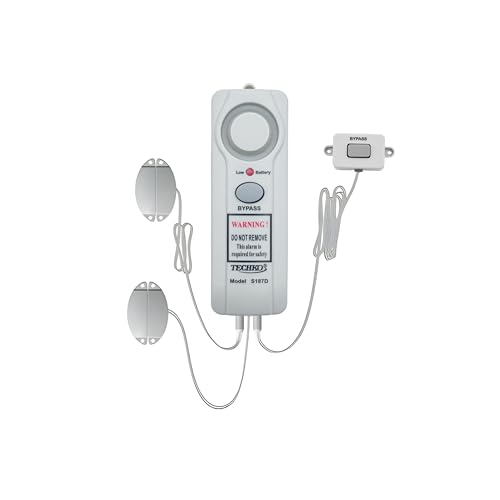
The Techko S187D is designed to pass pool inspections and meet UL 2017 safety standards, making it a suitable pick for buyers who require certified compliance. It delivers a high-volume alarm (110-115 dB) with six distinct tones to ensure alert visibility. A blinking LED indicates alarm status, and two bypass buttons allow a temporary 10-second disable for safe entry or maintenance. Best for households prioritizing regulated safety with a highly audible alert. Caution: Bypass temporarily disables alarm, so use only when necessary and resume monitoring promptly.
Pool Alarm With Indoor Receiver (ZapWay)

This unit pairs a floating pool alarm with an indoor receiver, creating a dual-alert system. It features an adjustable sensitivity setting and a robust 110dB siren that sounds at both pool and indoor units when water movement is detected. It is best for homes with large or multi-area layouts where an indoor alert is valued. Better for larger backyards; it monitors up to a 20′ x 40′ area. Caution: For larger spaces, consider multiple alarms to ensure full coverage.
PA-30 Pool Patrol Alarm

The Pool Patrol PA-30 emphasizes independently tested reliability with ASTM Safety Specification F2208 alignment. Installation is straightforward: place the floating unit in the pool and adjust sensitivity as needed. It provides a strong 85+ dB alert at 10 feet and can monitor a pool up to 20′ x 40′ with a single unit. Best for buyers who want a regulation-backed solution with simple setup. Limitation: A single unit may not suffice for very large or irregular-shaped pools—multi-unit configurations can help extend coverage.
IC ICLOVER Pool Alarm With Remote Receiver

The IC ICLOVER system uses a water-motion sensor to trigger a remote receiver. The setup supports four working modes—Surveillance, Swimming, Mute, and Off—allowing customization to different scenarios and reducing false alarms. It suits households seeking wireless monitoring across multiple zones or rooms, with an emphasis on rapid notification. Best for users who value flexible modes and a remote audible alert. Caution: Test the alarm after installation to confirm responsiveness and avoid missed alerts during critical times.
LunaSafe Immersion Pool Alarm Kit (2 Transmitters)

The LunaSafe kit includes one receiver and two transmitters, offering broad coverage with up to 100 feet line-of-sight range. Additional transmitters are available, enabling expansion for larger or multi-pool properties. Best for families needing multi-point detection around the pool area and the ability to scale as needed. Limitation: Availability of extra transmitters should be planned according to pool layout to ensure consistent coverage.
Buying Guide: Key Considerations For Choosing A Child Pool Alarm
What type of pool do you have? Inground, above-ground, soft-sided, or hybrid setups may benefit from different alarm designs (floating vs. motion-sensor vs. wireless receivers).
How loud should the alarm be? Prioritize alarms with 85 dB or higher to ensure audible alerts across yards and indoor spaces.
Is indoors monitoring important? Systems with indoor receivers help caregivers respond quickly, especially in large backyards or multi-area homes.
Do you need regulatory compliance? Some products are certified to ASTM F2208 or UL standards, which can simplify inspections and align with local safety requirements.
Can the system be expanded? If you have a larger or multi-pool property, choose solutions that support additional transmitters or multiple units.
How easy is installation and maintenance? Look for battery-powered designs with straightforward setup and minimal tools, plus clear testing steps to verify operation.
Frequently Asked Questions
- What is the typical range of a pool alarm? Range varies by model; many floating units work effectively up to 20′ x 40′ pools, while wireless systems may extend coverage with receivers.
- Do pool alarms require professional installation? Most are designed for simple, tool-free installation, though some larger systems benefit from a quick professional setup.
- Will an alarm work for pets too? Many pool alarms detect water entry from any weight; some models are specifically marketed for child and pet safety.
- Can alarms be muted in certain situations? Several models offer a temporary bypass or mute mode to allow safe entry or maintenance, but alarms should be reactivated afterward.
- How do I test an alarm’s effectiveness? Regularly test according to the manufacturer’s instructions, triggering the sensor to confirm audible and visual alerts function properly.
- Are these alarms compliant with safety standards? Some products are designed to meet ASTM F2208 or UL 2017 standards; verify the model you choose meets your local requirements.