The best boost pedal with EQ adds clean volume and precise tone shaping without muddying your signal. This guide reviews five top options, highlighting who each pedal is best for and why it stands out. Ideal buyers include studio players needing transparent boost, live performers seeking punchy mids, and pedalboard enthusiasts craving compact, flexible controls.
Summary table
| Product | Best For | Key Benefit |
|---|---|---|
| Friedman Buxom Boost | Transparent boost with EQ on/off | High headroom; EQ bypass for pure signal |
| SONICAKE Clean Boost | Budget-friendly clean boost | Simple gain control; buffer preserves tone |
| JHS Clover | Versatile mid-cut and boost | Flexible 3-band EQ and unity gain option |
| EX 7-Band Mini EQ | Precise studio-style EQ | 7 bands, +-15 dB; true bypass |
| Empress ParaEq MKII | Parametric control and clean headroom | Linked/Independent EQ, high headroom |
Friedman Amplification Buxom Boost Guitar Effects Pedal

Best for players who want plenty of headroom and a transparent boost. This pedal adds volume while keeping the signal clean, with a three-band EQ that can be bypassed for a completely unaltered tone. It supports 9V or 18V power for higher headroom on demanding rigs. Choose this if you prioritize transparency and robust clean boosts in a rugged package.
Who it’s best for: Players needing clean, high-headroom boosts for driving amps or enhancing solos without introducing extra color.
Caution: If you routinely need heavy EQ shaping, you may want a dedicated EQ in a separate pedal for deeper tone sculpting.
SONICAKE Clean Boost Pedal with Buffer

Best for players seeking a compact, budget-friendly boost with signal integrity. This pedal offers a clean boost with a buffer and a gain range up to 12 dB, plus on/off control. It’s a practical choice for beginners or pedalboard setups where space and cost matter. It preserves tone when engaged and remains clear in the signal path when bypassed.
Who it’s best for: Beginners, gigging players with small boards, and anyone needing a straightforward boost without color.
Caution: The gain range tops at 12 dB, which may be limiting for players seeking heavy boost or preamp drive.
JHS Pedals JHS Clover Preamp/Boost

Best for players who want significant tone shaping alongside a boost. The Clover provides a unity volume option and three EQ controls (Bass, Mid, Treble) plus a three-position rotary switch offering Full EQ, No Mid, or No EQ. This configuration helps sculpt precise tonal contrasts for different sections of songs or live settings.
Who it’s best for: Musicians who need flexible mid/treble control and a clear boost to push pedals or amps without changing overall volume too much.
Caution: The extra EQ stages can be more complex to dial in for players seeking a straightforward, minimal pedal experience.
EX 7 Band EQ Equalizer Mini Guitar Pedal
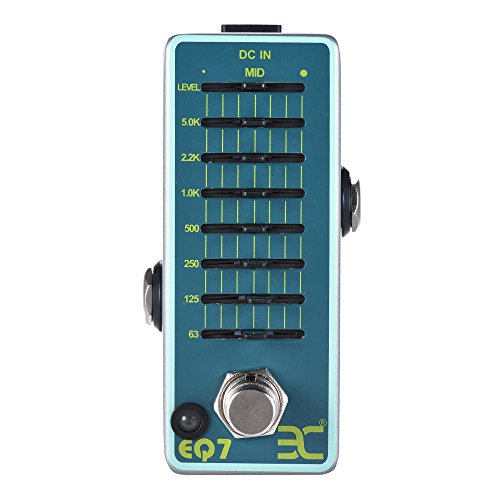
Best for studio-like tone shaping in a compact form. This mini EQ offers seven bands from 63 Hz to 5 kHz with ±15 dB boost/cut per band and true bypass. It preserves your core tone while enabling precise adjustments to remove muddiness or enhance presence, making it ideal for players who need detailed EQ control on a small board.
Who it’s best for: Players focusing on precise tonal adjustments in tight pedalboards or studio setups.
Caution: The 7-band layout requires more dialing time to dial in optimal settings compared to simpler boost-only pedals.
Empress Effects ParaEq MKII

Best for players needing both parametric EQ and clean boost with substantial headroom. The ParaEq MKII offers switchable EQ/Boost that can be linked or independent, a high clean headroom via 27V internal operation, and 15 dB boost/cut per parametric band. This gives broad tonal sculpting while preserving signal clarity.
Who it’s best for: Players who want premium control over frequency bands with reliable headroom for their boosted signal.
Caution: The more advanced controls may be overkill for players seeking a simple boost without EQ complexity.
Laney Black Country Customs TI-BOOST

Best for players seeking a Tony Iommi signature boost with robust construction. This pedal offers signature gain characteristics and can run on battery or PSU. Its solid metal chassis provides reliable stage performance for players who value durable construction and a distinctive boost feel.
Who it’s best for: Stage players who want a recognizable boost tone with sturdy build quality and flexible power options.
Caution: Signature-style boosts may not be ideal if you prefer a highly neutral, studio-grade boost without unique tonal flavor.
Buying Guide: Key Considerations When Choosing a Boost With EQ
- Purpose: Do you need transparent volume, tone shaping, or both? If you want color, choose a pedal with more EQ bands and boost options.
- Headroom: Higher headroom helps prevent clipping at loud stages. Pedals offering 18V operation or robust internal headroom are better for aggressive rigs.
- EQ Type: Graphic six-band, seven-band, or parametric EQs each offer different precision. Parametric EQs provide deeper, sweepable control over narrow frequencies.
- Bypass Quality: True bypass minimizes signal coloration when the effect is off. This is crucial for preserving your guitar’s natural tone.
- Form Factor and Build: Compact boards save space but ensure the pedal’s footprint fits your layout. Durable enclosures are a plus for live use.
- Power Options: Versatile power inputs (9V/18V or optional PSU) can influence headroom and performance on larger rigs.
- Ease of Use: For live performance, consider how quickly you can dial in your preferred boost and EQ settings.
Frequently Asked Questions
- What is a boost pedal with EQ best used for? It adds clean volume while allowing tone shaping to cut or boost specific frequencies.
- Should I buy a fixed-curve boost or a parametric EQ boost? Fixed-curve boosts are simpler; parametric EQ boosts offer precise, adjustable tone control.
- Is true bypass important for a boost pedal? Yes, it helps preserve your guitar’s natural tone when the pedal is off.
- Can a boost with EQ replace an amp EQ? A boost with EQ can complement an amp EQ, but it may not fully substitute a dedicated EQ or preamp in every situation.
- Which pedal is best for live use on a crowded board? A compact model with reliable buffer and simple controls tends to perform best in live environments.
- Do I need different pedals for clean boost versus preamp drive? Yes—some pedals excel at transparent boosts, while others offer more harmonic drive when driven with high headroom.