Bass players seeking expressive, dynamic effects can benefit from envelope filter pedals that respond to picking dynamics and swing the tone from subtle to buzzy. This guide highlights five top options, explaining who they’re best for and why. Whether you play funk, fusion, or groove-based rock, these pedals help you shape attack, decay, and frequency content for a punchy, musical envelope filter sound.
Buyer’s quick summary
| Product | Best For | Key Benefit |
|---|---|---|
| FLAMMA FC11 Auto Wah Pedal | Players needing compact, pure analog warmth | Warm, lush envelope with true bypass |
| MXR Bass Envelope Filter | Classic, reliable funk and groove tones | Simple controls with clean dry/shaping blend |
| Electro-Harmonix Nano Q-Tron | Flexible, studio-friendly bass tones | Drive, Q, and filter-mode options for versatile sweep |
| Behringer B-TRON III | Budget-conscious players seeking vintage tones | Three filter types and modes for versatile funk sound |
| MXR Blackout Series Bass Envelope Filter | Stylish, low-end-preserving performance | Separate Dry and Effect controls with striking aesthetics |
FLAMMA FC11 Auto Wah Pedal Envelope Filter

The FLAMMA FC11 provides a pocket-size, all-analog envelope filter suitable for both guitar and bass. Its pure analog circuit yields a lush, warm sound with a dynamic auto wah response. Best for players who want a compact pedal that preserves low-end integrity when engaged. A key limitation is its smaller footprint, which may constrain ultra-fine control on complex pedalboards.
MXR Bass Envelope Filter Pedal

The MXR Bass Envelope Filter is a straightforward, reliable option with a bypass footswitch, LED indicator, and dedicated Dry and Fx controls. It’s a strong choice for players who want predictable performance and clear separation between the clean bass signal and the filtered effect. Best for: funk and groove players who value consistent response and easy dialing. Limitation: fewer tonal shaping options compared to multi-parameter models.
Electro-Harmonix Nano Q-Tron Envelope Filter

The Nano Q-Tron offers a flexible envelope filter with Drive, Q, and a mode switch (LP/ BP/ HP). This setup lets players tailor the filter sweep range and tone to different basses and styles. Best for: players seeking broad control over filter behavior and frequency emphasis. Caution: some users may prefer more straightforward two-button setups for quick gig changes.
MXR Blackout Series Bass Envelope Filter
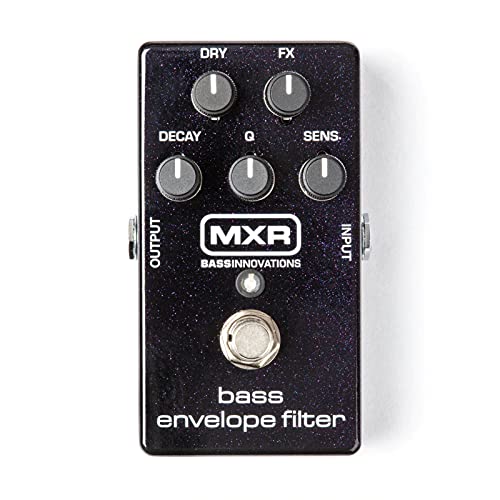
The MXR Blackout Series Bass Envelope Filter combines a stealthy matte housing with a bright LED and separate Dry and Effect controls. This design preserves the bass’s low end while delivering a pronounced envelope sweep. Best for: players who want a stage-ready, aesthetic-appealing pedal with clear low-end preservation. Limitation: matte finish may attract fingerprints and dust.
Behringer B-TRON III Envelope Filter Pedal

The Behringer B-TRON III provides three filter types (low-pass, band-pass, high-pass) and two modes for versatile, vintage-inspired tones. It’s best for players seeking classic “wah” or vowel-like textures at a budget, with true bypass for tone preservation when off. Limitation: older-style control layout may require a moment to dial in precise settings.
Buying Guide
Key considerations when choosing a bass envelope filter pedal:
- Sound character: Do you want classic funk “wah” vibes or a modern, versatile filter with multiple modes?
- Control layout: Are you comfortable with few knobs or do you want extensive control over Dry, FX, Q, and SENS?
- Low-end integrity: Is preserving the bass’s low end important when the effect is engaged?
- Footprint and build: Do you need a compact unit for a small pedalboard or a visually distinctive, rugged unit?
- Power and compatibility: Ensure you have compatible power supplies and avoid mismatched adapters.
FAQ
- What is an envelope filter pedal used for on a bass?
Answer: It shapes the signal in real-time based on your playing dynamics, producing wah-like sweeps and vowel-like tones. - Do I need a dedicated bass envelope filter or will a guitar pedal work?
Answer: Dedicated bass pedals are typically voiced to preserve low frequencies and deliver bass-friendly response. - Can I use envelope filters with both passive and active basses?
Answer: Most models work with both, but impedance and output level can influence performance. - Are analog or digital envelope filters better for bass?
Answer: Analog pedals tend to provide warmer, more musical sweeps; digital options may offer broader filter modes. - Is true bypass important for envelope filters?
Answer: True bypass helps maintain signal integrity when the pedal is off, avoiding tone loss. - Can envelope filters be used in live situations with other effects?
Answer: Yes; they pair well with overdrive, fuzz, and octave pedals for complex textures.