People seeking back pain relief can explore a range of exercise machines designed to stretch, stabilize, and strengthen the spine and surrounding muscles. This guide highlights five top options that balance safety, ease of use, and effective results for home use. Each pick emphasizes core back health—from inversion and extension to targeted core work and therapeutic modalities—so you can compare features, benefits, and suitability for your routine.
| Product | ||
|---|---|---|
| YOLEO Gravity Inversion Table (Red02) | Inversion Table | Reduces pressure on discs and nerves; safe inverting with triple protection |
| Sunny Health & Fitness 45-Degree Hyperextension (SF-BH6629) | Hyperextension Bench | Targets lower back, glutes, and hamstrings with foldable design |
| YOLEO Gravity Inversion Table (Blue02) | Inversion Table | Similar safety and comfort with headrest and durable frame |
| AONGA Spine Twist & Stretch Trainer | Spine/Torso Stretch Device | Dynamic lumbar stretch for relief and core conditioning |
| MERACH Vibration Plate | Vibration Plate | Stimulates circulation and lymphatic flow for overall comfort |
YOLEO Gravity Inversion Table With Headrest (Red02)

The YOLEO inversion table combines a heavy-duty steel frame with a comfortable backrest and secure ankle locking. Its triple protection safety features include an adjustable ratchet ankle lock and a safety pin system to keep users secure during inversion. This design aims to help decompress the spine, relieve nerve pressure, and promote natural muscle relaxation. The back support uses memory foam, and the ergonomics are crafted to fit the waist curve for usability and comfort during sessions. The table is designed to be user-friendly, enabling easy return to the upright position with simple arm movements.
Key considerations: Inversion therapy can provide temporary relief by reversing axial loading on the spine, but users should start slowly to monitor tolerance. The unit’s stability and secure locking mechanisms are important for safety, especially for beginners. Regular checks of the frame and ankle system are recommended to maintain performance and safety over time.
Sunny Health & Fitness 45-Degree Hyperextension Bench (SF-BH6629)
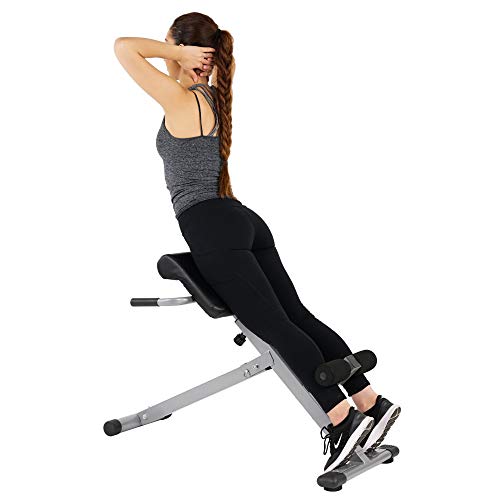
This 45-degree hyperextension chair targets the lower back, hips, and glutes. A compact and sturdy steel frame is designed for home use, with a foldable profile that saves space when not in use. The bench supports a range of motion suitable for progressive back strengthening, posture improvement, and core engagement. Its foldability makes it easy to store in small areas, which is ideal for apartment setups or shared spaces. Users should ensure proper setup and alignment to maximize the benefits while minimizing the risk of strain.
Key considerations: Because it focuses on spinal extensors and posterior chain muscles, it’s most effective as part of a balanced program including core and mobility work. The foldable design is a major advantage for space-saving home gyms, but ensure the bench locks securely during use.
YOLEO Gravity Inversion Table With Headrest (Blue02)

This blue variant mirrors the Red02 model with a heavy-duty steel frame, headrest, and adjustable protective belt. It emphasizes safety with a robust ankle locking system and a safety pin mechanism to control inversion depth. The ergonomic backrest uses memory foam to reduce pressure on the lower back during therapy and stretching sessions. Users can benefit from realigning the spine and reducing muscular tension through controlled inversion, while the durable construction supports longer-term use.
Key considerations: If you value a consistent home inversion routine, this model offers similar safety features in a different color and aesthetic. As with other inversion products, gradual acclimation is important, and users should seek medical advice if they have questions about inversions for certain conditions.
AONGA Spine Twist And Stretch Trainer

The AONGA spine twist device emphasizes dynamic lumbar stretching and core activation. Its mechanism guides safe twisting and torsion that can ease muscle tension in the lower back while engaging the waist and abdominal muscles for improved support. The device is designed to be compact, making it suitable for small spaces, and aims to offer a straightforward method to promote spinal mobility and daily flexibility. The focus is on safe, controlled motion that complements other back health efforts.
Key considerations: Twist-based devices can benefit users who need targeted lumbar relief and core engagement. It’s important to follow the manufacturer’s instructions and avoid aggressive twists if back pain is acute. Pairing with a broader program that includes gentle stretching and mobility work can enhance outcomes.
MERACH Vibration Plate Exercise Machine

The MERACH vibration plate combines deep mechanical stimulation with a sizeable 440-pound capacity. Its 13 mm amplitude aims to activate deep muscles and fat cells, boost circulation, and support lymphatic drainage. Built-in Bluetooth and a speaker allow users to listen to music while exercising, which can improve consistency and engagement. Silicone pedal pads offer a comfortable, non-slip surface, contributing to a safer overall experience during vibration sessions. This option supports whole-body energy and can complement targeted back routines with low-impact movement.
Key considerations: Vibration training can aid in posture and circulation but may not be suitable for everyone, especially those with certain joint or medical conditions. Start at a low intensity and gradually increase as tolerance builds. Ensure proper stance and avoid overexertion during initial sessions.
Buying Guide: Key Considerations For Back Health Equipment
Choosing the right back-focused exercise machine involves assessing your goals, space, and safety needs. Consider these perspectives to help tailor your selection:
- Purpose and target area: Inversion tables primarily decompress the spine, hyperextension benches strengthen the posterior chain, twist trainers offer mobility, while vibration plates support circulation and whole-body conditioning. Align the device with your primary goal—pain relief, posture, or core strength.
- Safety and stability: Look for robust frames, secure ankle systems, and clear user guidelines. Inversion gear should include locking mechanisms and easy return to the upright position. For mobility devices, ensure smooth motion with comfortable contact points.
- Space and storage: Foldable benches and compact designs fit smaller spaces. If space is limited, consider multi-use units that integrate several functions without crowding a room.
- Ease of use and comfort: Padding, ergonomic backrests, and intuitive controls contribute to sustainable routines. Materials like memory foam can improve comfort during longer sessions.
- Progression and compatibility: A device should accommodate gradually increasing intensity or range of motion. Devices that pair with apps or Bluetooth audio can enhance motivation and track progress over time.
- Medical considerations: If you have a history of spinal conditions, disc herniation, osteoporosis, or acute injuries, consult a healthcare professional before starting new inversion, traction, or vibration routines.
When evaluating options, compare the core attributes: safety features, construction quality, and how well a device integrates into a balanced back health regimen. A well-rounded program may combine a primary device for spinal relief with supplementary tools for core strength, flexibility, and gentle mobility work.