Answering the need for adaptable, comfortable work surfaces, this guide highlights the best adjustable height lab tables and workbenches. These selections suit teachers and students in science labs, technicians in workshops, and hobbyists who require ergonomic height customization. The top picks emphasize ease of height adjustment, sturdy construction, and practical dimensions for common lab tasks. Read on to compare features, ideal users, and any limitations to help you choose confidently.
| Product | Best For | Key Benefit |
|---|---|---|
| NPS Adjustable Height Science Lab Table, 24″ x 48″ | Standard classroom labs | Smooth 1″ increments, compact footprint |
| Global Industrial Adjustable Height Workbench, 96″ W x 36″ D | Large bench needs | Long, stable top with heavy-duty capacity |
| National Public Seating SLT3-2460C, 24″ x 60″ | Chem-resistant classroom labs | Chem-res top, easy 1″ height adjustments |
| National Public Seating SLT3-2454C, 24″ x 54″ | Compact chem lab spaces | Similar chem-res build, flexible sizing |
| FLEXISPOT Adjustable Height Workbench | DIY projects & craft spaces | Hand crank height control, storage drawer, mobility |
NPS Adjustable Height Science Lab Table, 24″ x 48″

The National Public Seating NPS table is an affordable, compact option ideal for standard science labs or classroom stations. It features steel legs that adjust smoothly in 1″ increments, with a height range from 22.25″ to 37.25″. The 14-gauge square tubing offers durability for daily use, and the phenolic top provides a resistant surface for common lab activities. This table is best for teachers seeking a reliable, budget-friendly adjustable surface for a single-station setup and smaller rooms.
Best for: standard lab stations, classrooms with tight spaces. Limitations: not designed for extremely heavy instrumentation or extensive multi-station configurations.
Global Industrial Adjustable Height Workbench, 96″ W x 36″ D

This Global Industrial workbench prioritizes length and stability for high-demand environments. Its 96″ width with a 36″ depth provides ample workspace, and the adjustable legs support customization for various users. The top’s birch surface plus a robust frame make it well-suited for heavy-duty lab or workshop use. A notable feature is the removable duplex knockouts for optional outlets, enabling power access without extra wiring work. Choose this when you need a long, sturdy station capable of handling larger experiments or projects.
Best for: large labs, technical workshops, or classrooms needing expansive surface area. Caution: installation of electrical outlets requires additional components and planning.
National Public Seating SLT3-2460C, 24″ x 60″

The SLT3-2460C from National Public Seating uses a chem-resistant high-pressure laminate (Ch-res) top with a 1″ core, offering a tough work surface for chemistry labs or technical classes. The steel frame ensures stability, and height adjustment occurs in 1″ increments for precise ergonomics. This model is best for labs that require a longer table with a resilient surface and straightforward height tweaks. Limitation: the 60″ length may be ideal for long stations but can consume significant floor space in smaller rooms.
National Public Seating SLT3-2454C, 24″ x 54″
This SLT3-2454C model provides a slightly shorter alternative to the 60″ variant while maintaining a chem-resistant top and robust steel legs with smooth height adjustment. It is well-suited for compact lab layouts or smaller classrooms that still require a sturdy, adjustable surface. Recommended for: spaces needing a reliable medium-length station with resilient surface. Caution: ensure the top load aligns with the intended science activities to avoid overloading the core.
FLEXISPOT Adjustable Height Workbench
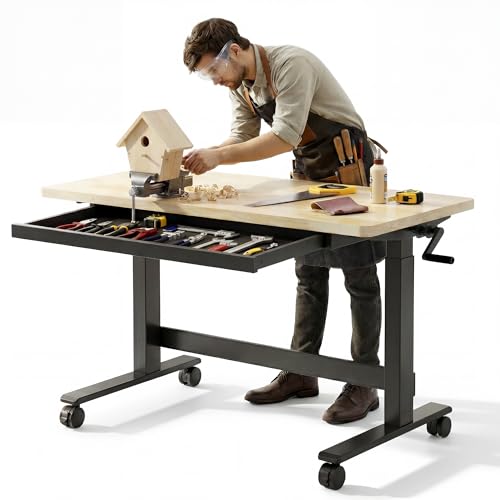
The FLEXISPOT workbench offers a precise hand-crank height adjustment from 28.27″ to 44″ and includes a built-in storage drawer plus four 360° lockable casters. This makes it ideal for mixed-use spaces such as DIY shops, small labs, and classrooms that require frequent reconfiguration and mobility. The top measures 47.24″ by 23.62″, providing a compact yet functional surface. Choose this if you want a versatile, mobile bench with added storage and straightforward height control. Limitation: crank adjustment may be slower than electric options for frequent height changes.
Flash Furniture Wren Mobile 36″ x 72″ Table Set

This option combines a table with four chairs, featuring a 36″ depth and 72″ length, and a grey laminate surface. It suits group activities, teaching sessions, and collaborative labs where mobility and flexible seating are valuable. Best for: classrooms or studios that require ready-to-use, all-in-one furniture sets. Limitation: not designed for ultra-heavy lab equipment; intended for lighter, collaborative work.
Global Industrial Adjustable Height Mobile Workbench

This option emphasizes mobility with a sturdy steel frame and a 72″ W x 30″ D workspace. The 1-1/2″ stainless top adds resilience for various lab tasks, and the frame is gray for a professional look. It also features removable duplex knockouts for easy electrical installation. Best for: dynamic labs or shops needing a mobile, large-capacity surface. Caution: stainless top requires proper care to maintain finish and prevent scuffs.
Buying Guide
When selecting an adjustable height lab table, consider expected tasks, space, and user needs. The top material matters: phenolic and chem-resistant laminates perform well in science labs, while wood or birch tops suit woodworking or general crafts. Height range is critical for ergonomic comfort; look for consistent increments (1″ is common) and a stable base. For large spaces, opt for longer, wider tables; for compact rooms, shorter or foldable designs help conserve floor area. Mobility features like casters add flexibility but may affect stability when locked. For labs needing outlets, check if the design supports integrated power access or if separate wiring is required.
FAQ
- What height is considered ergonomic for most lab tasks? A typical comfortable height is about elbow level when standing, usually around 28″ to 36″ for general tasks, but adjust based on user height and whether the user sits or stands.
- Are chem-resistant tops necessary for biology labs? For chemistry or wet labs, chem-resistant laminates help resist spills and staining, improving longevity and hygiene.
- Should I choose a long workbench or several small tables? Long benches provide uninterrupted work areas and stability; multiple smaller tables offer flexible configurations and denser layouts in tight spaces.
- Do I need built-in outlets? If you frequently plug in equipment, choose a model with knockouts or outlet options; otherwise plan for surface-mounted power access to reduce wiring complexity.
- Is mobility important for my space? If rooms reconfigure often, casters with locking brakes are advantageous; for permanent labs, a stationary table may reduce wobble and improve stability.
- How important is weight capacity? Consider typical loads; labs with heavy devices require robust frames and thicker tops to prevent sagging over time.