If you need to centralize and protect large collections of photos, videos, backups, or work files, a five-bay drive enclosure can simplify management while delivering ample capacity. These enclosures support multiple 2.5″ and 3.5″ SATA drives, offer hot swapping, and can connect through USB interfaces for fast transfers. This guide highlights five strong options, detailing who each is best for, with practical notes on setup, noise, and expansion potential.
Summary table of selected products
| Product | Best For | Key Benefit | Limitations |
|---|---|---|---|
| ORICO 5 Bay USB 3.0 | Home storage and family backups | High capacity up to 110TB; tool-free setup | Linux read limitation across multiple drives |
| CENMATE Aluminum 6 Bay | Quiet office or studio storage | Aluminum cooling with dual fans | Fan noise may be noticeable |
| SABRENT 5-Bay USB 3.2 Gen 2 | Performance-focused backups and media | 10Gbps USB-C, independent drive power | No RAID built in |
| CENMATE Aluminum 4 Bay | Medium-scale data library | Solid cooling, high capacity per drive | 4 bays only |
| ORICO 5 Bay USB 3.1 Enclosure | Creative projects and heavy editing | Fast 110TB total capacity and 22TB per drive | Does not include RAID |
ORICO 5 Bay USB 3.0 Enclosure with Tool-Free Setup
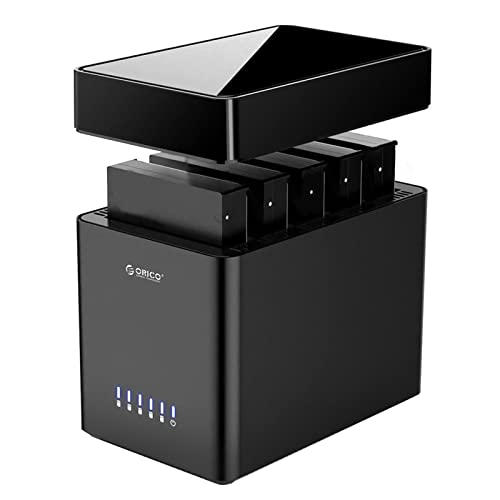
This 5-bay enclosure from ORICO emphasizes easy, screw-free assembly via magnetic latches. It supports 2.5″ and 3.5″ SATA drives and claims a massive total capacity of up to 110TB (22TB per drive). It uses USB 3.0 with a 5Gbps transfer ceiling and works with Windows, macOS, and Linux, though Linux systems may limit read access to one drive at a time when multiple drives are present. Best for families and home offices needing rapid expansion without tools.
Best for: Home storage and family backups where quick setup and high capacity matter most.
Limitations to note: In Linux environments, multi-drive visibility can be limited; consider dedicated backups or a single-drive workflow if Linux is primary.
CENMATE Aluminum 6 Bay HDD Enclosure With Cooling Fans

This 6-bay system targets users who need significant external storage with active cooling. It supports 2.5″/3.5″ drives up to 20TB per drive and houses two built-in 2.7-inch fans to manage heat. USB 3.0 provides up to 5Gbps transfer speeds. It’s well-suited for small offices and power users who handle large backups or media libraries. Note that fan noise averages around 40-50 decibels, which may be noticeable in quiet environments.
Best for: Users seeking high-capacity external storage with cooling for performance-heavy tasks.
Limitations to note: Noise can be audible in quiet rooms; consider placement away from the primary workspace.
SABRENT 5-Bay USB 3.2 Gen 2 Docking Station

The SABRENT DS-SC5B provides a direct-attached storage experience with five independent drives and no RAID, allowing each drive to function separately. It supports USB 3.2 Gen 2 up to 10Gbps, making it suitable for backups, large media libraries, and fast data transfers. Individual drive power switches help manage drives without shutting down the entire unit. Best for: Professionals who want flexible, drive-by-drive control and top transfer speeds.
Limitations to note: No integrated RAID means you cannot combine drives into a single volume via this enclosure.
CENMATE Aluminum 4 Bay Enclosure with Cooling

This is a 4-bay option from CENMATE aimed at users needing a more compact external storage solution with strong cooling. It supports 2.5″/3.5″ drives up to 20TB per drive, and USB 3.0 with up to 5Gbps transfers. Aluminum construction and active cooling help maintain performance for longer workloads. Best for: Small businesses or enthusiasts who don’t need a full five-drive setup but still demand robust cooling and size efficiency.
Limitations to note: Fewer bays mean lower total raw capacity unless you plan to combine multiple enclosures.
ORICO 5 Bay USB 3.1 Enclosure With High-Capacity Potential

ORICO’s 5-bay enclosure with USB 3.1 (and 12V/10A power) emphasizes maximizing total capacity, offering up to 110TB across all drives with 22TB per bay. It provides a 2-in-1 USB/Type-C data cable and supports plug-and-play across Windows, macOS, and Linux. This model suits users who require a stylish, high-capacity desktop solution. Best for: Creative professionals and data hoarders who need expansive, plug-and-play expansion.
Limitation to note: RAID is not included; if you need a single volume across all drives, you’ll need a separate software solution or different hardware configuration.
Buying Guide: Key Considerations For 5-Bay Enclosures
- Drive compatibility and capacity: Check the supported drive sizes (2.5″ vs 3.5″), per-drive maximum capacity, and total bay capacity to match your planned data load.
- Interfaces and speed: USB 3.0/3.1/3.2 Gen 2 offer different theoretical speeds. If you work with large media or backups, higher Gen interfaces reduce transfer times.
- Cooling and noise: Aluminum enclosures with built-in fans improve longevity under heavy use. Note the typical noise range and place the unit accordingly.
- RAID vs. no RAID: Several models provide no RAID by design, offering independent drive access. If you need a single pooled volume, plan alternative configurations or a different chassis.
- Tool-free vs. tool-based assembly: Tool-free designs speed up setup, but verify security features like drive locks or hot-swap mechanisms if you handle sensitive data.
- Expansion potential: Consider daisy-chain capabilities if you foresee growing beyond five drives. Some models support daisy chaining for substantial capacity.
- Operating system compatibility: Ensure compatibility with Windows, macOS, and Linux if you switch systems or share data across devices.
- Power requirements: Review power adapter specs to confirm compatibility with your workspace power setup and ensure adequate amperage for multiple drives.
FAQ
- What is a DAS enclosure and when should I use it?
A direct-attached storage (DAS) enclosure provides external drive access via USB or similar interfaces, suitable for fast access and local backups without network sharing.
- Do I need RAID in a 5-bay enclosure?
Not necessarily. Many 5-bay units offer independent drive access and no RAID by design, which is ideal for flexible setups. RAID might be unnecessary unless you specifically require data redundancy or a single volume.
- Can I mix 2.5″ and 3.5″ drives in one enclosure?
Yes, most 5-bay enclosures support both sizes, but confirm each device’s maximum drive compatibility and mounting method before mixing.
- Is cooling essential for high-capacity enclosures?
Yes. Drives generate heat, especially when many bays are active. Enclosures with aluminum bodies and built-in fans help maintain performance and longevity.
- Will Linux recognize all drives at once?
Some multi-drive enclosures may present visibility restrictions on Linux systems. Check user notes for multi-drive visibility constraints and plan backups accordingly.
- What’s the advantage of a 10Gbps USB-C dock over USB 3.0?
Higher bandwidth reduces transfer times for large files or multi-disk operations, beneficial for editing high bitrate video or bulk data transfers.