What matters most when choosing a 150 GPD RO system is reliable filtration, ease of installation, and space-efficient design. This guide highlights five 150 GPD RO systems that suit hobbyists, aquarists, home drinkers, and small labs. Each option is evaluated for who it’s best for, plus a clear rationale and a potential limitation.
Summary table of chosen products:
| Product | Best For | Why Pick |
|---|---|---|
| iSpring RCC1DP Tankless RO/DI | Aquarium owners and labs needing fast output | Tankless, high flow with DI stage for ultra-pure water |
| iSpring RCC1D Tankless RO/DI | Compact setups with minimal space | Tankless design, minimalist footprint |
| HydroLogic Stealth RO150 | General home use with adjustable waste ratio | Stealth design, adjustable waste-to-product water |
| Aquatic Life 4-Stage 150 GPD | Aquarium or hydroponics fans | Four-stage system, includes essential cartridges |
| SpiroPure SP-RO400AQD 150 GPD | Compact, countertop or apartment setups | 4-stage with DI final stage, high flow |
iSpring RCC1DP Tankless RO/DI System

The RCC1DP uses tankless RO/DI filtration with a pump to sustain performance in low-pressure environments. It claims robust impurity reduction across more than 1,000 pollutants, including lead, chlorine, fluoride, and TDS removal. Its 150 GPD membrane supports faster production, making it suitable for aquariums, laboratories, and dental or microelectronics applications where a steady supply of clean water is critical.
Best for: Aquarium hobbyists and small labs needing quick, steady output with DI polishing for ultra-pure water. This model is ideal where space is constrained but high throughput is required.
Limitation: The system relies on pump performance; in very low-pressure situations or without adequate power, output may decline.
iSpring RCC1D Tankless RO/DI System

The RCC1D emphasizes a minimalist, tankless design that sits well in tight spaces while delivering a practical 150 GPD flow. It includes a DI stage and addresses a broad pollutant range, including lead removal and complete TDS reduction. The device is aimed at aquarium setups, dental practice water needs, and other environments that benefit from space optimization without sacrificing water quality.
Best for: Compact installations where space is at a premium and a high-output RO/DI solution is required for continuous use.
Limitation: The tankless design can involve a more complex installation to ensure proper filtration and drainage, depending on mounting and plumbing constraints.
HydroLogic Stealth RO150

The Stealth RO150 is a three-stage system featuring a 1 RO membrane, a green coconut carbon filter, and a 1:1 or 2:1 waste-to-product water ratio option. It claims 98%+ contaminant removal and includes a pressure gauge and auto shut-off valve for efficient operation. This system suits general household use and small scale applications where straightforward maintenance is desired.
Best for: Home users seeking a traditional RO setup with predictable performance and adjustable waste ratio to balance water conservation with production rate.
Limitation: It’s a three-stage unit, which may provide less post-filtration polish compared to four-stage systems in environments with higher contaminant loads.
Aquatic Life 4-Stage 150 GPD RO System
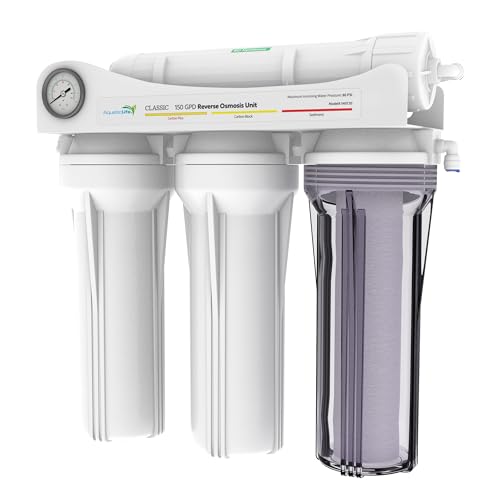
This Aquatic Life unit provides up to 150 GPD with four filtration stages. It reduces chlorine, heavy metals, and total dissolved solids, delivering filtered water suitable for hydroponics or aquariums. The kit includes essential wrenches and cartridges, aiding in straightforward setup and routine maintenance.
Best for: Aquarists and hydroponic enthusiasts who want a complete four-stage system with reliable 150 GPD output and essential accessories included.
Limitation: The system’s performance can vary with feed water quality; higher TDS feeds may require additional pre-filtration to maintain efficiency.
SpiroPure SP-RO400AQD 150 GPD RO/DI
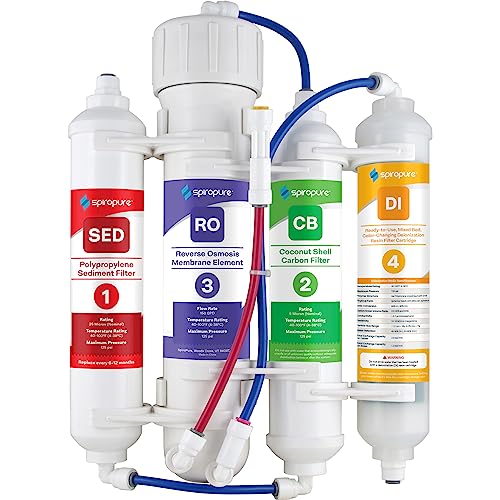
The SpiroPure SP-RO400AQD combines RO purification with DI final filtration, configured for up to 150 GPD. Its fourth-stage DI cartridge uses mixed-bed resin for enhanced TDS reduction, and colorful indicators warn when cartridges are exhausted. This model is designed for users wanting fast, high-purity output with straightforward cartridge monitoring.
Best for: Apartment dwellers or compact setups needing a robust four-stage unit with DI polishing and clear cartridge indicators.
Limitation: DI cartridges require timely replacement to maintain water purity; neglecting indicator cues can lead to reduced water quality over time.
Buying Guide: Key Considerations For A 150 GPD RO System
- Filter stages and polishing: More stages typically yield higher water purity. Consider 3-4 stages plus a DI post-filter for ultra-pure water in sensitive applications.
- Tankless vs. tanked: Tankless designs save space and can be more compact, but ensure your plumbing supports a steady flow and pressure. Tanks provide consistent water pressure but take more space.
- Waste water ratio: Some units offer 1:1 or 2:1 waste-to-product water. A higher ratio wastes more water but can improve membrane life in hard water; balance water conservation with production needs.
- Output and feed water conditions: 150 GPD is a peak rate under optimal pressure (~60 psi). If your water supply is low pressure, a system with a built-in pump or booster may be preferable.
- DI polishing: If your goal is ultra-pure water (low TDS), consider a DI stage after RO to reduce residual ions further.
- Space and installation: Measure available space and check compatibility with under-sink or countertop configurations. Some tankless models require specific mounting or inline fittings.
- Maintenance and cartridges: Review cartridge lifetimes and replacement costs. Systems with clear indicators help time changes to maintain water quality.
FAQ
- What does 150 GPD mean?
– It indicates the system’s maximum production rate, or gallons per day, under optimal conditions. - Do I need a DI filter if I already have RO?
– A DI filter can further reduce total dissolved solids for ultra-pure water, which is useful for aquariums, labs, and certain hydroponics. - Is a tankless RO system harder to install?
– Tankless models save space and can be media-compact, but installation may require careful plumbing to ensure steady flow and pressure. - Can these systems handle hard water?
– Yes, many 150 GPD RO systems perform well with hard water, though pre-filtration (sediment and carbon) is often recommended to protect membranes. - How often should I replace cartridges?
– Replacement intervals depend on water quality and usage; indicator lights or maintenance schedules provided by the unit help plan replacements. - Is 150 GPD enough for a family?
– For typical home use and small aquariums, 150 GPD is ample, but very high daily consumption or large multi-tain systems may require higher capacity or multiple units.