Common buyer intent: finding a reliable 120W LED grow light that delivers solid full-spectrum performance for accross seedling to flowering stages. This guide highlights five strong 120W-class options and clearly explains who each is best for, including practical caveats. Suitable for small tents, balconies, and home gardens, these picks emphasize efficiency, spectrum quality, and ease of use.
| Product | Coverage | Best For | |
|---|---|---|---|
| HHNMAHN 120W LED Grow Light | 2×2 ft | Small tents and seedling stages | Full spectrum with precise dimming |
| UAP1200 LED Grow Light | 2×2 ft / 3×3 ft | Versatile grow tents | Sunlike spectrum, deep penetration |
| TheOneGrow MA1200 | 2×2 / 3×3 ft | High-efficiency setups | High yield with efficient cooling |
| UAP1500 LED Grow Light | 2×2 / 3×3 ft | Medium to larger grow areas | Boost mode and full spectrum |
| KingLED KP1000 | 2×2 ft | Budget-conscious 2×2 grow tents | VEG/BLOOM modes with efficient design |
HHNMAHN 120W LED Grow Light Full Spectrum
Best for: Home gardeners needing full-spectrum, dimmable control in a compact 2×2 ft footprint. This unit uses a GL1 full-spectrum layout with 304 LED beads and a PPE of about 2.2-2.8 μmol/J, delivering balanced light from seeding through flowering. The 100W base power can scale up to 120W, with stepless dimming for precise intensity matching plant stage requirements. An IP65 waterproof driver supports challenging humidity in grow tents or greenhouse corners.
Why selected: The combination of full-spectrum performance, adjustable brightness, and broad temperature tolerance makes this ideal for compact indoor grows. The IP65 rating adds resilience in humid environments. Caution: ensure adequate air movement to prevent heat buildup in enclosed spaces during high-output use.
UAP1200 LED Grow Light for Indoor Plants
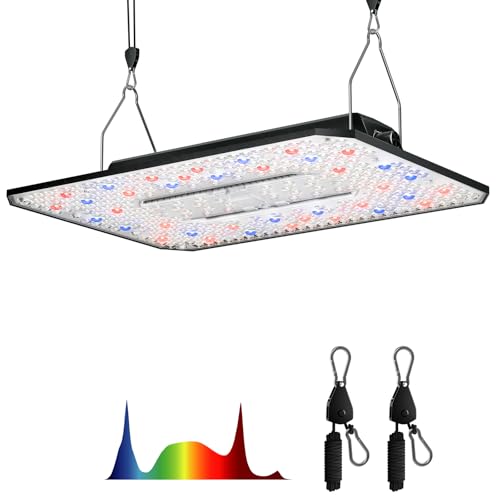
Best for: Grow tent setups needing uniform light and deeper canopy penetration across 2×2 ft or 3×3 ft spaces. Features a sunlike full spectrum (6200K White, 437nm Blue, 660nm Red, 730nm IR) with enhanced 660nm/IR wavelengths to boost flowering and crop quality. Aluminum construction aids heat dissipation for low-maintenance operation.
Why selected: Its optimized spectrum and efficient heat management support steady growth from seedling to harvest. Caution: check electrical compatibility in non-standard outlets; the unit favors stable power supplies for long runs.
TheOneGrow MA1200 Grow Light Full Spectrum

Best for: Growers seeking high efficiency with a 120W draw and strong red/far-red emphasis for robust flowering. The MA1200 provides a true full spectrum with 660nm red, 3000K warm white, 5000K cool white, and 730–740nm far-red, coupled with a finned aluminum heatsink for cooling. Ideal for 2×2 or 3×3 tents and vertical racks.
Why selected: The design emphasizes cooling and sustained output, supporting steady growth and improved yields. Caution: may require dimming or height adjustment to match plant stage and distance to canopy for optimal results.
UAP1500 LED Grow Light

Best for: Medium to larger 2×2 or 3×3 ft grow tents needing higher output and a dedicated Veg/Flower mode switch. This 150W fixture uses full-spectrum diodes with Veg/Flower modes, offering a balanced spectrum with 6200K white and red/IR boosts for flowering. It includes a daisy-chain feature for expanded setups and robust heat management.
Why selected: The dual-mode control and full-spectrum design support reliable cycles from seed to harvest. Caution: higher power may require more vertical space to prevent canopy burn in tight setups.
KingLED KP1000 LED Grow Light

Best for: Enthusiasts seeking a 100W option with veg and bloom modes in a cost-efficient setup for a 2×2 ft area. Features sunlike full spectrum, including 460nm blue and 660nm red with 3000K-5000K white, and a simple VEG/BLOOM switch. It supports two dimensions of growth in compact tents or shelves.
Why selected: The simplicity of control paired with efficient spectrum makes it a practical pick for beginners or budget-focused growers. Caution: not a dimmable model; you’ll need to position it precisely to adjust intensity via height rather than dimming.
Buying Guide: Key Considerations For 120W LED Grow Lights
- Spectrum and growth stage alignment: Look for true full-spectrum daylight-like white light plus targeted red and IR wavelengths for flowering and fruiting phases.
- PPFD and efficiency: Choose lights with higher efficiency (μmol/J) and adequate PPFD at the canopy to support rapid vegetative growth and robust flowering without excessive energy use.
- Heat management: Effective heat sinks and ventilation extend LED lifespan and maintain stable output. Consider fanless designs with good heatsinking for quiet operation in living spaces.
- Fixture footprint vs. canopy coverage: Ensure the fixture covers your 2×2 ft or nearby area with even intensity. Gun for uniform center-to-edge PPFD.
- Durability and environmental tolerance: IP rating matters in humid tents or hydroponic setups. Waterproof or water-resistant drivers add reliability in challenging conditions.
- Control features: Stepless dimming, built-in timers, and smart app control can save time and improve growth precision across multiple plants.
- Installation considerations: Assess mounting options (hanging vs. standing), ceiling height, and whether daisy chaining is needed for larger systems.
FAQ
What makes a 120W LED grow light suitable for a 2×2 ft tent?
It provides sufficient light intensity and even coverage for most vegetables and leafy greens, while keeping power use reasonable and heat output manageable within a compact space.
Is dimming necessary on a 120W fixture?
Not always, but dimming helps tailor intensity to seedling versus flowering stages and can reduce light waste in small spaces.
Should I choose a fixture with a daisy-chain feature?
Daisy chaining is beneficial if you plan to expand your setup later or run multiple fixtures in larger tents.
What is the difference between Veg and Bloom modes?
Veg mode emphasizes greens and vegetative growth; Bloom mode enhances flowering and fruiting. Some models combine both in a single spectrum with mode switching.
Do I need a dimmable light for beginners?
A non-dimmable light with adequate output and height-adjustable setup can be effective, but dimmable options offer greater flexibility as you gain experience.
Are 120W lights energy efficient?
Yes, especially when delivering a high PPFD at canopy level. They balance power draw with ample light for compact spaces.