Looking for the most powerful electric tiller to handle tough soil, hard-packed beds, or large garden plots? This guide selects five highly capable options and explains who they’re best for. Each choice emphasizes raw tilling power, durability, and ease of use for American homeowners with varying soil conditions. If you need deep, wide-coverage tiling, or a nimble cordless option for raised beds, you’ll find clear, practical reasons to choose one over another.
Summary at a glance: the top five picks here are Sun Joe TJ604E, LawnMaster TE1318M, DESOON 40V cordless tiller, DEKOPRO 40V cordless tiller, and MZK TC12A03 (12-Inch, corded). Use the Buying Guide below to compare width, depth, motor power, and runtime to match your garden size and soil type.
Sun Joe Corded Electric Tiller TJ604E — Best For Medium Lawns And Small Gardens

The Sun Joe TJ604E is a corded electric tiller powered by a 13.5-amp motor. It tills up to 16 inches wide and 8 inches deep, making soil preparation efficient for lawns and moderate garden beds. Steel tines are rust-proof and durable, ensuring steady performance over time. Its folding handle design makes storage and transport easy for homeowners with limited space. Best for gardeners who want reliable power without gas engines and who often work in smaller spaces.
Best for: homeowners with medium-sized plots and a need for consistent, straightforward tilling without refueling. Limitations: corded operation means you’ll manage power extension and cable routing in dense beds or tight spaces.
LawnMaster TE1318M — Best For Larger Gardens

The LawnMaster TE1318M offers a sizable 18-inch cutting width and a 9-inch tilling depth, driven by a 13.5-amp motor. Six rust-resistant steel blades deliver robust soil breakdown, making it suitable for medium to large gardens that need thorough prep. It includes mechanical overload protection to automatically shut off if the tines become blocked, helping to prevent damage. This is a strong choice for growers who tackle heavy, compacted soil and larger beds.
Best for: gardeners with sprawling plots who require faster coverage and deeper soil loosening. Caution: potential over-tilling risk in very loose soil; monitor depth settings to avoid soil disruption in delicate beds.
POGGT 21V Cordless Tiller — Best For Mobility And Raised Beds
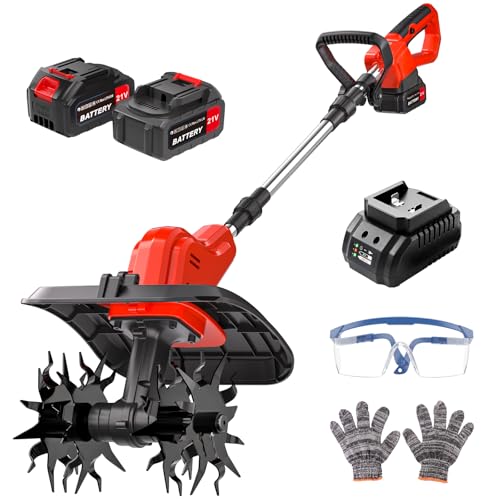
The POGGT cordless tiller runs on a 21V system with two 4.0Ah batteries, offering up to about 60 minutes of runtime under light use. It tilts to an 11.8-inch width and 6.6-inch depth at 360 RPM, a compact option ideal for inter-row work, seedbed prep, and small beds. Foldable shaft and dual safety switches promote safe operation and easy storage. Best for: gardeners who value cordless convenience and need a light, portable tool for small-to-medium beds. Caution: may require frequent recharging for larger projects or tougher soils.
Electric Tiller From etoolab — Best For Broad Garden Prep

This 15-amp model powers through broader garden prep with an 18-inch tilling width and 9-inch depth. Aimed at large beds and vegetable plots, it emphasizes high-till efficiency and robust 24 steel blades. The model is wired for continuous operation, making it a solid pick for gardeners who require consistent power and wide coverage. Best for: those pursuing substantial soil turnover in larger plots. Caution: heavy for casual or balcony gardening; may require more storage space.
MZK 12-Inch Corded Tiller — Best For Small To Medium Beds

With a 12-inch width and 8-inch depth, the MZK model uses a 10-amp motor to deliver steady performance in small to medium beds. Its lightweight design and rust-resistant blades support quick soil turning and seedbed preparation. Best for: gardeners who need a simple, reliable option for tighter plots and raised beds. Caution: not ideal for very large plots or deeply compacted soil.
Buying Guide: Key Considerations For The Right Electric Tiller
How To Choose By Tilling Width And Depth
Wider tiling widths (18 inches and up) cover ground quickly but may be heavier and harder to maneuver. Narrowers (12–16 inches) are easier to handle and suited for raised beds. Depth matters for root zone preparation; 6–9 inches is common for most home gardens. Match width and depth to your bed size and soil hardness.
Motor Power And Performance
Higher amperage generally translates to stronger soil penetration in dense soil. Corded models with 13–15 amp motors provide robust performance for mid-to-large gardens. Cordless options trade constant power for portability and lighter weight; battery voltage and amp-hours determine runtime and power.
Durability, Tines, And Maintenance
Steel, rust-resistant tines prove more durable across seasons. Six to eight tines are common for efficient soil breakup. Look for foldable handles or compact designs if storage space is limited. Consider models with safety switches to prevent accidental starts and easy cleanup capabilities.
Corded Versus Cordless Considerations
Corded tillers offer constant power without recharging interruptions, ideal for larger stretches of the garden. Cordless units provide mobility and are better for raised beds and tight spaces, though runtime depends on battery capacity. Evaluate your garden layout and access to power outlets when choosing.
Ease Of Use And Safety Features
Ergonomic handles, adjustable height, and clear safety features help reduce fatigue and risk during extended tilling sessions. Dual safety switches, foldable shafts, and reliable shutoff mechanisms provide safer operation for occasional and novice users alike.
Frequently Asked Questions
- What tiller width is best for small raised beds? A width of 12–16 inches is typically ideal for raised beds, offering good maneuverability while delivering sufficient soil turnover.
- Are cordless tillers powerful enough for heavy soil? Some cordless models with 40V or higher systems handle moderately compacted soil, but for very hard or clay soil, corded models with higher amperage often perform more consistently.
- How deep can an electric tiller usually go? Most electric tillers reach 6–9 inches of tilling depth, depending on model and soil conditions.
- Is maintenance on electric tillers difficult? Maintenance is generally low. Regularly clean tines, check for rust, and inspect safety features. Gas models require more ongoing upkeep, whereas electric units mostly need electrical checks and basic cleaning.
- Should I choose a tiller with overload protection? Overload protection helps prevent damage when the tines hit obstructions, which is beneficial for preventing stalling and extending tool life.
- Which tiller is best for large garden plots? A model with an 18-inch width and a deep tilling depth, paired with a robust 13–15 amp motor, is typically best for large plots, reducing overall work time.