If you’re looking to add loop layering to your acoustic guitar performances, these pedals deliver reliable looping, easy usability, and clear audio. This guide targets players seeking simple, studio-friendly loops, live performers who want quick overdubs, and songwriters who need instant riff-building tools. Below, five top picks are evaluated for versatility, record time, and user-friendliness. A quick comparison table highlights core specs to help you choose quickly.
| Product | Best For | Loop Time | Key Benefit |
|---|---|---|---|
| BOSS RC-1 Loop Station Pedal | Beginners to intermediate players | 12 minutes | Simple, proven reliability |
| LEKATO Looper Guitar Pedal (9 Loops) | Multi-section songs | 40 minutes total | Long memory with multiple loops |
| Donner Triple Looper | Live players needing three scenes | 90 minutes | Bright visual screen for live control |
| LEKATO Looper Pedal With Sync & Tuner | Precise timing and tuning on the fly | 18 minutes | SYNC and built-in tuner |
| BOSS RC-5 Loop Station | Advanced users with MIDI and I/O needs | 13 hours | 32-bit processing and extensive connectivity |
BOSS RC-1 Loop Station Pedal

The BOSS RC-1 is a straightforward looping pedal designed for quick setups and reliable performance. It operates with a single stomp footswitch and offers basic loop creation, overdub, and undo/redo features. Best for guitarists who want a no-fuss looper that’s easy to learn and dependable during gigs. Its 12-minute record time suits short songs or practice sessions. A potential limitation is that it lacks more advanced features found in higher-end models, but its simplicity reduces setup time on stage.
LEKATO Looper Guitar Pedal (9 Loops)

LEKATO’s 9-loop looper provides more complex arrangement options with separate loops and a substantial total recording time (up to 40 minutes). It supports 48K/24-bit uncompressed audio for clean tone and includes a built-in tuner. This pedal is well-suited for players who want to build layered parts across sections of a song. The interface relies on a single-knob operation, which may require a setup period for new users. Best for performers who value organized loop banks and longer practice sessions.
Donner Triple Looper

The Donner Triple Looper stands out with three independent loops and up to 90 minutes of combined recording time. It features a bright, high-visibility screen to track loop status and timing, useful for live performance. It uses a single footswitch approach, simplifying control for beginners while remaining capable for more complex song structures. Best for players who need distinct loop sections (verse, chorus, solo) without constantly erasing tones. A potential limitation is the need to rely on the screen for status during performances in bright environments.
LEKATO Looper Pedal With Sync & Tuner Function
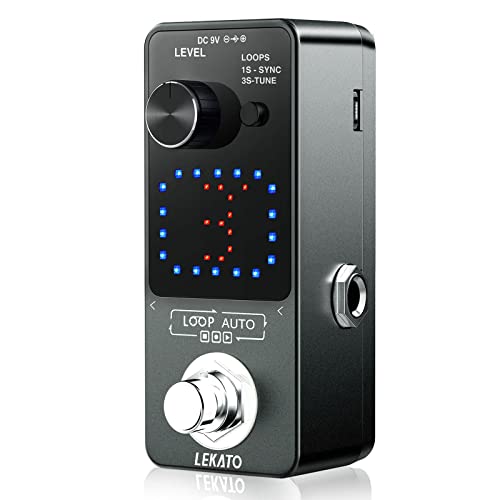
This LEKATO model emphasizes synchronized recording and a built-in tuner, helping performers keep timing tight throughout layered sections. It provides 3 loops with a modest 18-minute total record time and a straightforward interface. Best for players who need on-the-fly tuning and reliable pitch alignment while building layered parts. A caution: power supply requirements and setup specifics should be verified before use to ensure stable operation in live settings.
BOSS RC-5 Loop Station

The BOSS RC-5 brings more advanced looping features in a compact package, including 32-bit AD/DA and 32-bit floating-point processing for cleaner loop audio. It offers onboard rhythms, phrase memories, backlit displays, and expanded connectivity like MIDI/IO and USB. Best for performers who want greater sonic control, longer looping capabilities, and integration with other gear. A limitation to note: the feature set demands a bit more learning curve compared with entry-level loops.
Buying Guide
What should you consider when choosing an acoustic guitar loop pedal?
- Loop time vs. memory: Do you need long performances or quick practice loops?
- Number of loops: Are you layering multiple sections (verse, chorus, bridge) or sticking to one loop at a time?
- Audio quality: Look for 24-bit or higher sampling rate and dry-through options to preserve acoustic tone.
- Synchronization and tuning: Built-in tuner and sync features help keep timing tight during live play.
- Interface and footprint: Footswitch count, screen visibility, and size affect live usability.
- Connectivity: MIDI, USB, and stereo inputs/outputs enable integration with amps, interfaces, and DAWs.
Buying considerations by scenario
- Live performers who want reliability and ease of use: Start with simpler models like BOSS RC-1 or Donner Triple Looper for straightforward looping.
- Songwriters building multi-part arrangements: Choose pedals with multiple loops and longer total recording time, such as LEKATO 9-loops or Donner Triple Looper.
- Players needing precise timing and tuning: Look for loopers with built-in tuner and sync features, such as LEKATO Looper with Sync & Tuner or RC-5 with advanced processing.
- Studio-oriented players integrating with gear: Consider devices offering USB/MIDI connectivity for seamless DAW workflows, like BOSS RC-5.
Frequently Asked Questions
- What is a loop pedal used for with an acoustic guitar?
A loop pedal records a phrase and plays it back in a repeating loop, enabling layering of chords, melodies, and harmonies in real time.
- Do loop pedals affect acoustic tone?
Quality looper circuits aim to preserve tone; models with dry-through or high sample rates help maintain natural acoustic color.
- Is more expensive always better for loopers?
Not always. For beginners, simpler pedals reduce learning curve and setup time; advanced players may benefit from additional features like MIDI and multi-loop banks.
- Can I use a loop pedal with a guitar and a microphone?
Yes, many loopers accept instrument and voice inputs, but check input types and level controls to avoid clipping.
- Which pedal is best for live performances?
Pedals with clear displays, reliable footswitches, and sufficient memory—like Donner Triple Looper or BOSS RC-5—tend to perform well on stage.
- Do loop pedals require power adapters?
Most do; verify the required supply voltage and connector type and ensure the adapter is included or available separately.