Searching for sturdy, corrosion-resistant steel cable for railing systems? This guide highlights top stainless steel cable options and practical buying tips. It targets buyers building or upgrading deck, stair, or balcony railings who need durable, marine-grade performance. The selections below are framed for different projects: residential decks, coastal locations, DIY railings, and professional installations. Each product section explains who it’s best for and why it was chosen, with clear trade-offs to help you compare quickly.
| Product | Diameter | Length | Breaking Strength | Best For |
|---|---|---|---|---|
| CELYND 500FT 1/8″ | 1/8″ | 500 ft | 1800 lbs | Coastal decks and DIY railing projects |
| Muzata 500 ft 1/8″ | 1/8″ | 500 ft | 1800 lbs | Indoor/outdoor railing with long runs |
| CELYND 250FT 3/16″ | 3/16″ | 250 ft | 3700 lbs | Outdoor deck railings with higher load needs |
| KALLSDY 500FT 1/8″ | 1/8″ | 500 ft | 1780 lbs | Coastal or high-use areas requiring flexibility |
| ZONEGRACE 1000FT 1/8″ | 1/8″ | 1000 ft | 1800 lbs | Large projects and long spans |
CELYND 500FT 1/8″ Stainless Steel Cable for Railing

Best for: DIY deck railings and marine environments where long runs are needed. This 7×7 strand 1/8″ cable is marine-grade, rust-resistant, and designed to withstand outdoor exposure. The kit includes a cutter for clean, edge-free length adjustments. CELYND emphasizes durability for both indoor and outdoor applications, making it a reliable choice for porch railings and elevated decks.
Why selected: High-strength 1800 lb breaking strength with a practical safe tension of 260 lbs fits common railing loads. 500 feet provides ample length for long spans without frequent joins. The smooth surface reduces fraying and hand injuries during handling.
Caution: Long runs may require careful alignment to avoid excessive sag; plan posts and turns to minimize stretch over distance.
Muzata 500 ft 1/8″ Stainless Steel Cable Railing System

Best for: Indoor and outdoor railings where a clean, unobtrusive view is desired. The 1/8″ 7×7 construction is flexible yet strong, with a robust 1800 lb breaking strength that supports common residential loads. Coastal environments are well-supported thanks to T316 stainless steel.
Why selected: The kit’s compatibility with a professional cutter (recommended) helps achieve precise, fray-free cuts. The 500-foot length covers long railing runs with fewer joints, and the 7×7 construction adds kink resistance compared to 1×19 variants.
Caution: Plan for contingencies—allow extra length for gates or corners, and verify posts’ spacing to maintain tension consistency.
CELYND 250FT 3/16″ Stainless Steel Cable
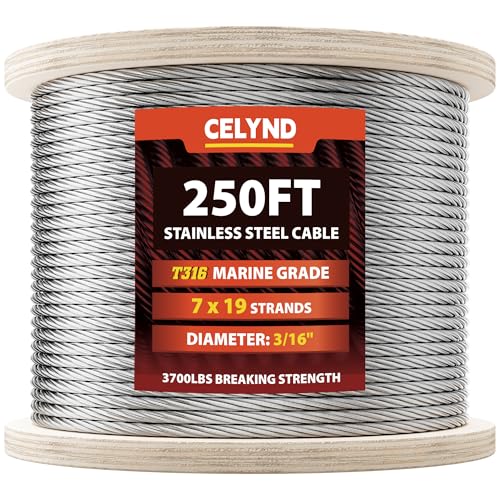
Best for: Outdoor deck railings with higher load requirements. The 3/16″ diameter offers greater rigidity and strength for more demanding setups, such as stair rails or heavy-use sections in coastal areas.
Why selected: This 7×19 strand variant delivers higher breaking strength (3700 lbs) than the 1/8″ options, enabling taller balustrades or longer unsupported spans. The T316 marine-grade material boosts corrosion resistance in challenging environments.
Caution: Heavier cables require sturdier posts and careful tensioning; ensure hardware and connectors match the rope diameter to prevent slippage.
KALLSDY 500FT 1/8″ Stainless Cable

Best for: Coastal or high-use environments where you need flexibility and resilience. The 7×7 construction provides good bendability for complex rail layouts while maintaining strength.
Why selected: 1780 lb minimum breaking strength with a 570 lb working load and 340 lb safety load supports typical residential railing loads with room to spare. 2% molybdenum in the 316 stainless steel enhances corrosion resistance in salty air.
Caution: Surface smoothness is important; lower burr risk reduces hand injury during installation, but gloves are still recommended when cutting and crimping.
ZONEGRACE 1000FT 1/8″ Stainless Cable

Best for: Large projects with long spans or multiple runs. The 1000-foot length reduces the need for frequent reorders and joins, ideal for professional installations or expansive decks.
Why selected: Premium T316 stainless steel delivers excellent corrosion resistance in coastal settings, with 1800 lb breaking strength and 260 lb safe tension. A long length supports projects with multiple sections or future expansions.
Caution: When installing across long spans, maintain even tension to prevent sag; consider post spacing and tensioning accessories to sustain uniformity.
Buying Guide: Key Considerations For Choosing Stainless Steel Cable Railings
- Material Grade: Look for T316 stainless steel for coastal and high-moisture areas due to its superior corrosion resistance compared to T304.
- Construction Type: 7×7 strands offer greater flexibility and easier bending, while 7×19 strands provide higher stiffness and load capacity. Choose based on project geometry and ease of installation.
- Diameter and Strength: Common sizes are 1/8″ and 3/16″. A larger diameter increases strength but requires sturdier posts and fittings. Verify the breaking strength matches your railing load requirements.
- Length And Spares: Longer runs reduce joints but require careful tensioning. Plan extra length (typically 10%) for contingencies and future adjustments.
- Hardware Compatibility: Ensure compatible swage fittings, cutters, and posts. Some kits include a cutter or recommend specific tools for clean cuts and reduced fraying.
- Finish And Aesthetics: Blackened or polished finishes affect appearance. Consider how the finish blends with your railing design and environment.
- Installation Environment: Coastal or poolside installations demand higher corrosion resistance. Verify whether the product is explicitly designed for indoor/outdoor use.
FAQ: Quick Answers For Stainless Steel Cable Railing Buyers
- What is the difference between 7×7 and 7×19 rope?
- Is 1/8″ cable strong enough for residential deck railings?
- Can I install stainless steel cable on wooden posts?
- Do I need special cutters for stainless steel cable?
- Should I choose T316 for coastal projects?
- How do I estimate total cable length for a railing project?