Vertical climbers offer a compact, full-body cardio workout that targets legs, glutes, core, and upper body with a low-impact motion. This guide highlights five popular models that balance stability, range of motion, and ease of use for American homes. Each entry includes key features to help you compare build quality, resistance, and foldability, making it easier to choose a climber that fits your space and fitness goals.
| Product | Brand | Key Benefit |
|---|---|---|
| Vertical Climber Exercise Machine (Newer Version) | RELIFE REBUILD YOUR LIFE | Four guide rails for stability |
| MaxiClimber XL-2000 | MaxiClimber | Bi-directional resistance, full-body workout |
| MaxiClimber 2.0 | MaxiClimber | Elastic resistance system, foldable |
| Sunny Health & Fitness SF-S024035 | Sunny Health & Fitness | Extended step range, app connectivity |
| MERACH Stair Stepper | MERACH | Total-body sculpting with extended stride |
RELIFE 4-Guide Rails Vertical Climber

The RELIFE vertical climber emphasizes four metal guide rails and accompanying lubricating grease to support a smooth, quiet workout. This newer version features a thickened step plate and reinforced foot supports, designed to reduce wear and improve stability during climbs. The design positions the pedals slightly inward to keep the center of gravity aligned with the main frame, enhancing balance during exercise. Weight capacity is listed at 260 pounds. This model aims to deliver a sturdy, low-noise climbing motion ideal for apartment-friendly cardio and strength routines.
MaxiClimber XL-2000 Vertical Climber
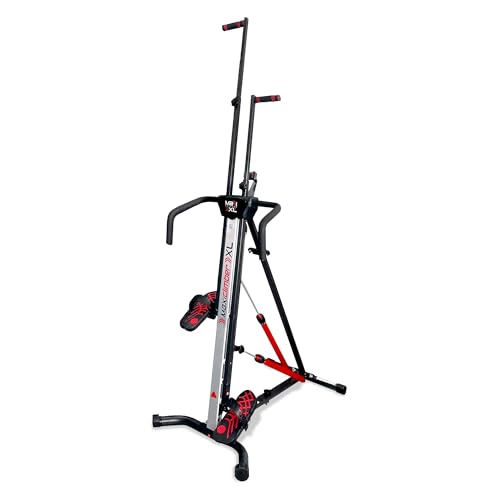
This full-body climber promotes a comprehensive conditioning routine by engaging arms, core, and legs in a single, fluid climbing motion. It features a bi-directional 12-level hydraulic resistance system to tailor the workout to your fitness level, from fat-burning intervals to building endurance. The device provides a low-impact vertical motion, making it suitable for users seeking joint-friendly cardio while still challenging major muscle groups.
MaxiClimber 2.0 with Elastic Resistance

The MaxiClimber 2.0 adds an elastic resistance system (ERS) that allows users to control resistance through bodyweight and added bands. The unit is foldable for easy storage, supporting full-body cardio and strength training with a focus on smooth, vertical motion that reduces knee and ankle strain. Ideal for compact spaces and users seeking adjustable intensity without heavy equipment.
Sunny Health & Fitness SF-S024035

This foldable cardio climber provides a full-body cardio and strength routine, designed to burn calories and tone muscles using bodyweight. The adjustable step height and stride length let users modulate workout intensity, while a focus on core stability helps improve balance and control. It pairs with an app to track progress and workouts, though the core workout can be performed without digital aids.
MERACH Stair Stepper

MERACH’s latest vertical climber focuses on an extended stride range and adjustable handlebar to customize reach and balance during climbs. The design emphasizes total-body engagement, with an emphasis on endurance and calorie burn in shorter workout windows. The unit is designed for compact storage and uses a robust frame to support sustained sessions and heavier users.
Buying Guide
- Workout goals: For fat loss and total-body conditioning, prioritize climbers with multi-point resistance, adjustable stride, and full-body engagement. Models with elastic resistance or hydraulic levels offer scalable intensity for beginners to advanced users.
- Foot and knee comfort: Look for curved or inward-leaning pedals, stable base frames, and smooth, low-impact motion. A wider pedal surface and knee-friendly mechanisms help reduce joint strain during longer sessions.
- Stability and build quality: Four-guide-rail designs and reinforced frames improve balance, especially for taller users. Check weight capacity and materials like alloy steel for long-term durability.
- Storage and footprint: Folding or compact designs save space in apartments or home gyms. Measure the available area and consider whether the unit can be moved or stored easily when not in use.
- Resistance and adjustability: Devices with multiple resistance settings, including hydraulic, elastic bands, or manual adjustments, enable progressive training and varied routines.
- Technology and monitoring: Some climbers integrate apps or digital feedback for pace, duration, and calories. Decide if you want digital tracking or a simple machine with no screens.
- Installation and maintenance: Look for straightforward assembly and accessible replacement parts, including lubricants and spare components, to keep the climber running smoothly over time.
Comparative considerations
- Stability vs. compactness: Heavier models with four guide rails tend to be more stable but require more storage space. Lighter, foldable models offer convenience at the potential cost of some stability during vigorous workouts.
- Resistance range: Hydraulic and elastic systems provide scalable intensity but may wear differently than mechanical or weight-based systems. Consider ease of maintenance and availability of replacement parts.
- Target audience: Some climbers emphasize athletic performance and endurance, while others focus on low-impact cardio and joint health. Choose based on how you plan to integrate climbing into your routine.