Find the right educational microscope series for teaching, homework, or hobby science. This guide focuses on clear, classroom-friendly options that offer solid magnification ranges, reliable illumination, and beginner-friendly features. The products below are suited for students, teachers, and enthusiasts who want dependable tools for exploration and observation. The summary table highlights each option to help you compare at a glance.
| Product | Magnification Range | Best For | Notes |
|---|---|---|---|
| AmScope B120 Series (1MP USB Camera) | 40X-2500X | HIGH SCHOOL LABS | LED illumination, Siedentopf head, economical for classrooms |
| AmScope B120 Series (5MP USB Camera) | 40X-2500X | COLLEGE LABS | Better imaging, still budget-friendly |
| AmScope M150 Series Portable Monocular | 40X-1000X | FIELD STUDIES | Portable, includes prepared slides |
| Carson MicroBrite Plus (MM-300) | 60X-120X | ON-THE-GO LEARNING | Pocket size, easy for quick observations |
| AmScope B120 Series (3MP USB Camera) | 40X-2500X | COMPREHENSIVE CLASSROOM USE | Solid value with mid-range camera |
AmScope B120 Series Student & Professional LED Binocular Compound Microscope — 40X-2500X (1MP USB)
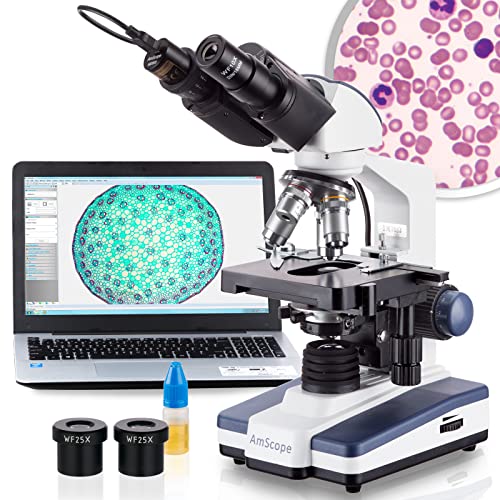
The AmScope B120 Series 1MP USB Camera model is designed for both students and professionals who need solid magnification and dependable optics. Its 40X-2500X range supports basic to advanced observations, from prepared slides to live samples. LED illumination with a fly-eye lens provides bright, daylight-balanced lighting that reduces shadows and helps reveal fine details. This version is best for teachers creating engaging lab activities and for learners who want a straightforward, school-friendly microscope with image capture capabilities for assignments or portfolios.
Best for: high school or entry-level college labs where students need clear images for notes and reports. The integrated USB camera supports digital capture without extra adapters, simplifying classroom workflows.
Limitation: The camera resolution is 1MP, which is lower than higher-end models; consider if higher-resolution imaging is essential for your curriculum or student projects.
AmScope B120 Series 40X-2500X with 5MP USB Camera
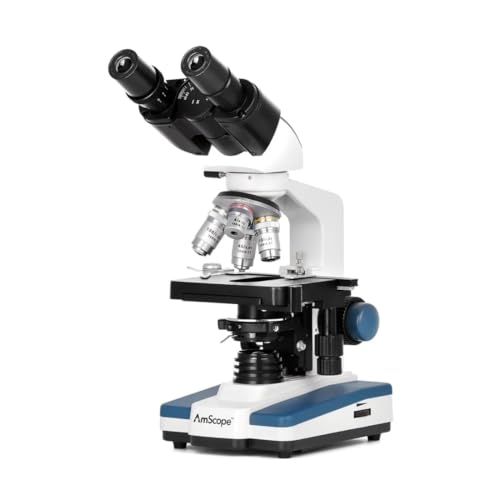
This B120 variant raises imaging quality with a 5MP USB camera while maintaining the same optical core that makes the B120 a classroom staple. The Siedentopf head, LED fly-eye illumination, and 40X-2500X magnification create an effective learning tool for observing cell structures, tissues, and micro-organisms. The higher camera resolution benefits science fair projects and digital presentations, making it a better option when students need high-quality images for reports.
Best for: labs or classrooms where students prepare digital reports, posters, or presentations and require sharper image capture than the 1MP version.
Limitation: Slightly higher cost and larger data files due to the 5MP sensor; ensure sufficient storage and processing in the classroom setup.
AmScope M150 Series Portable Monocular Microscope — 40X-1000X
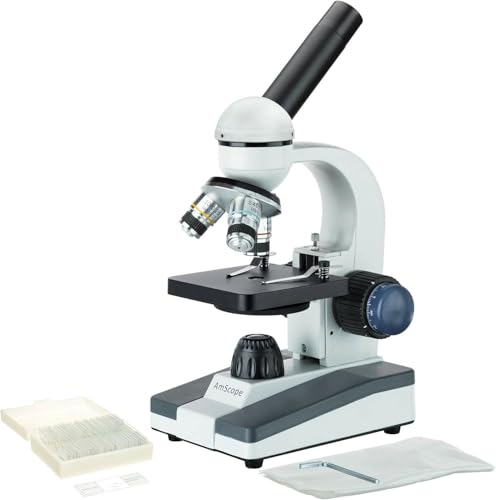
The AmScope M150 portable monocular microscope focuses on portability and practical field use. With 40X-1000X magnification, this model is ideal for students who move between classrooms and labs or perform field observations. It includes a set of prepared slides and a basic kit, making it a ready-to-use option for introductory biology or science clubs. The 360-degree rotatable monocular head supports flexible viewing angles, which helps accommodate different learners and seating arrangements.
Best for: students and hobbyists who need a lightweight, classroom-friendly instrument that travels easily between locations. Choose this if portability and a ready-made slide set are priorities.
Limitation: Monocular design means depth perception may be limited for 3D sample work; stereo or dual-head models may be better for those tasks.
Carson MicroBrite Plus 60x-120x Pocket Microscope

The Carson MicroBrite Plus is a compact, LED-illuminated pocket microscope suitable for quick checks and on-the-go learning. It offers a true 60X-120X magnification and is designed as a portable STEM toy that classrooms can hand out for quick, practical exploration. Its small size makes it ideal for field trips, science fairs, and supplementary activities where the main classroom microscope is not practical.
Best for: learners who need a compact, portable microscope for quick observations or demonstrations outside the lab. Use this as a supplemental tool rather than a primary classroom instrument.
Limitation: Limited magnification compared with full-size educational microscopes; not ideal for detailed cellular work or slide preparations requiring high resolution.
AmScope M150 Series Portable Monocular — 40X-1000X (Additional Kit)

This M150 variant expands on the field-ready design by including a broader educational kit and supplementary slides. The 40X-1000X range remains suitable for general biology activities, microscopy basics, and introductory cell observation. The solid metal frame and quality optics ensure durable use in busy classrooms or afterschool programs, making it a reliable option for ongoing learning projects.
Best for: classrooms that want a portable unit with a more comprehensive educational kit, enabling students to perform their own slide-based investigations without needing additional purchases.
Limitation: While portable, it lacks the dual-head binocular capability of some larger models, which may limit certain teaching demonstrations that require simultaneous two-view observations.
Buying Guide: Practical Considerations For Educational Microscopes
- Magnification needs: For beginners, 40X-1000X covers most introductory biology tasks. Higher ranges up to 2500X are useful for advanced studies but may be overkill for younger students.
- Optical quality and illumination: LED illumination with a diffuse or fly-eye lens helps produce bright, even lighting. Look for a stable light source and good contrast to reveal cellular details.
- Camera and image capture: If digital records or presentations matter, choose models with built-in USB cameras. Resolution matters for detailed documentation.
- Head design: A Siedentopf or binocular head enables both eyes to view comfortably for longer periods. Monocular heads are lighter and cheaper but can cause faster eye fatigue.
- Portability and kit contents: Portable models are ideal for field work and home use. Kits with slides, cover slips, and teaching guides add immediate classroom value.
- Durability and warranty: Metal frames tend to last longer in classroom settings. Consider whether the model you choose has a warranty or replacement parts available.
- Maintenance: Check if objectives are interchangeable, easy to clean, and compatible with standard slides. A simple cleaning routine extends lifespan.
Frequently Asked Questions
- What magnification is best for most classrooms?
– A 40X-1000X range covers introductory biology and microbiology well, balancing detail with ease of use. - Should I choose a binocular or monocular microscope for students?
– Binocular models reduce eye strain and are preferable for longer observation sessions; monocular units are lighter and often cheaper for younger students. - Is a built-in camera important?
– Built-in cameras simplify assignment creation and sharing of images, which is helpful for digital portfolios and class presentations. - Are portable microscopes suitable for the classroom?
– Yes, portable models support flexible learning, field trips, and quick demonstrations, but ensure they still offer adequate magnification and stability. - What should I consider when comparing kits?
– Look for included slides, cover slips, manuals, and the availability of spare parts or replacement components. - How durable are educational microscopes?
– Metal frames and standardized components tend to withstand frequent handling in classroom settings.