Finding the right sheet music stand depends on where you perform, how much you carry, and whether you prioritize height, stability, or quick setup. The following five stands are well-suited for student practice, small ensembles, bands, and on-the-go gigs. Each entry highlights who it’s best for, why it was selected, and a practical caveat. A quick comparison table follows to help you decide at a glance.
| Product | Best For | Key Benefit | Potential Limitation |
|---|---|---|---|
| On-Stage SM7211B | Orchestral players and travelers | Folding tripod base for easy storage | Bookplate size may limit very large scores |
| OnStage SM7022BB | Traveling performers needing detachability | Detachable bookplate and bag included | Fold-out extensions add setup steps |
| Vekkia Professional Portable Stand | School bands and traveling players | Wide height range and strong corrosion resistance | Heavier overall |
| CAHAYA Music Stand (Dual-Use) | Multi-use players (floor or desktop) | Two-in-one design with clamp-free desktop use | Tripod extension may be longer when used as desktop |
| GLEAM Sheet Music Stand | Gigging musicians needing strong grip | Deep tray with 180° tilt and height range | All-metal construction can be heavier |
On-Stage SM7211B Professional Grade Folding Orchestral Sheet Music Stand

The On-Stage SM7211B is designed for orchestral and ensemble use with a folding tripod base that eases transport and storage. It features a 13.5″ x 19″ bookplate with a 2″ return lip to secure sheets and a tension locking knob to adjust the bookplate angle. Best for performers who travel between venues and need a compact setup, as well as players who want a stable stand without sacrificing adjustment control. Caution: the bookplate is sturdy but large scores could require wider depth than the 13.5″ x 19″ area.
OnStage SM7022BB Detachable Sheet Music Stand
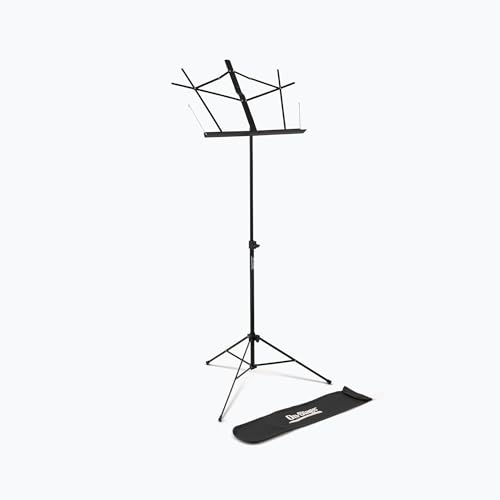
This stand is ideal for players who value portability and quick setup. The detachable, tilting bookplate holds three 8.5″ x 11″ sheets, with fold-out extensions to secure sheets in place. The stand is height adjustable, and the lower shaft folds down for compact travel. It suits students, small ensembles, and performers who switch between different venues. Caution: assembly and detachment add a few steps to setup compared with fixed stands.
Vekkia Professional Portable Sheet Music Stand

The Vekkia stand offers a broad height range from 32″ to 56″ for seated or standing use and emphasizes durability with a thick metal build and a three-layer anti-rust coating. Its carrying bag supports easy transport, making it a strong pick for travel, school bands, and solo performances. Best for players who perform frequently on different stages. Limitation: set-up and break-down can take longer than ultra-light options, adding time to stage changes.
CAHAYA Music Stand for Sheet Music – Dual-use
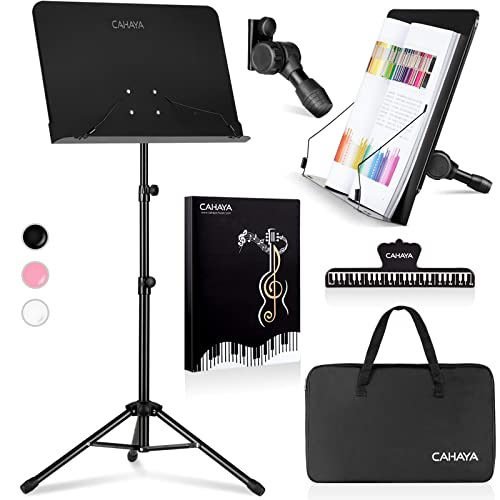
The CAHAYA dual-use design converts between a floor stand and a desktop stand, offering a 31.4″ to 57″ height range and a 2″ deep tray with reinforced spring arms to secure sheet music, tablets, or a light laptop. The portable carrying bag and quick adjustments support busy performers who need flexibility for different stage layouts. Better for performers who frequently switch between standing and sitting. Caution: some users may find the desktop mode requires detaching the bookplate for optimal stability.
GLEAM Sheet Music Stand – Full Metal with Carrying Bag

The GLEAM stand provides a deep 2-inch tray with reinforced high-tension spring arms to grip sheet music, tablets, or a lightweight laptop. It offers a full 180° tray tilt and an adjustable height range from 35″ to 55″. This makes it suitable for a wide range of performers, from guitarists and pianists to drummers and saxophonists. Limitation: all-metal construction can be heavier than plastic-based options, which may affect portability for some users.
Buying Guide: Key Considerations For Your Stand
- Intended use: Stage gigs vs. practice space. If you travel often, prioritize foldability and a sturdy carrying bag.
- Height range: Choose a model that accommodates your playing position (sitting vs. standing) and your instrument’s height needs.
- Bookplate size and depth: Ensure the tray depth and lip keep your sheets secure, especially for thick scores or tablet use.
- Adjustability: Look for smooth, easy-to-turn knobs and locking mechanisms that remain stable during performances.
- Portability vs. durability: Light stands travel well but may compromise on stability; heavier stands provide long-term reliability but may be bulkier.
- Flexibility: Dual-use or desktop capabilities can save space for home practice and studio work.
Frequently Asked Questions
- What is the best stand for traveling musicians?
– Stands with foldable bases, detachable bookplates, and a carrying bag are typically easiest to transport, such as the SM7211B or SM7022BB. - Do stands support tablets or laptops?
– Some stands offer reinforced arms and larger trays suitable for tablets or small laptops; check tray depth and weight capacity before use. - Is a dual-use stand worth it for students?
– Yes, if you need both floor-standing and desktop options without buying separate pieces. - Should I prioritize light weight or stability?
– For stage use with movement, stability matters most; for frequent travel, weight reduction should be balanced with sturdiness. - What height range is typically sufficient for most players?
– A range around 32″ to 57″ covers most seated and standing players across various instruments. - Are metal stands more durable than plastic ones?
– Generally, metal stands offer greater durability, but can be heavier. Choose based on your environment and handling frequency.