When accuracy matters for pool chemistry, choose a trusted test kit that delivers consistent, easy-to-read results. This guide highlights five highly reliable options, suitable for different buyer needs—from traditional liquid reagents to modern digital strips. The top picks are ideal for pool owners, hot tub enthusiasts, and spa managers who want clear guidance on water balance without guesswork. Below you’ll find concise product sections, a quick comparison summary, and practical buying tips to help you decide which test kit matches your pool setup and testing routine.
| Product | Best For | Why It Stands Out |
|---|---|---|
| Taylor Pool Water Test Kit (Complete) | All-around accuracy enthusiasts | Comprehensive 9-parameter testing with color-coded guide. |
| EASYTEST 7-Way Pool Test Strips | Budget-conscious, quick checks | 7-parameter coverage with large batch (150 strips). |
| Poolmaster 5-Way Test Kit | Clear color matching | Clear-view test block with integrated color chips. |
| Taylor K-1005 9-in-1 | Durable USA-made option | Extensive reagents in a portable case with simple instructions. |
| Lupo 3-in-1 Pool Test Kit | At-home quick checks | Three essential parameters with fast results. |
Taylor Pool Water Test Kit, Complete Swimming Pool Water Test Kit

This all-in-one Taylor kit tests for free and total chlorine, pH, acid/base demand, total alkalinity, calcium hardness, and cyanuric acid. It includes color-coded instructions and a waterproof chemistry guide for quick reference. Best for pool owners who want a single, comprehensive testing solution for regular maintenance.
Best for: home pool owners needing a complete, straightforward test with reliable reagents. The kit’s universal compatibility makes it suitable for pools, hot tubs, and spas. Caution: reagent replacement may be needed seasonally to maintain accuracy.
EASYTEST 7-Way Pool Test Strips
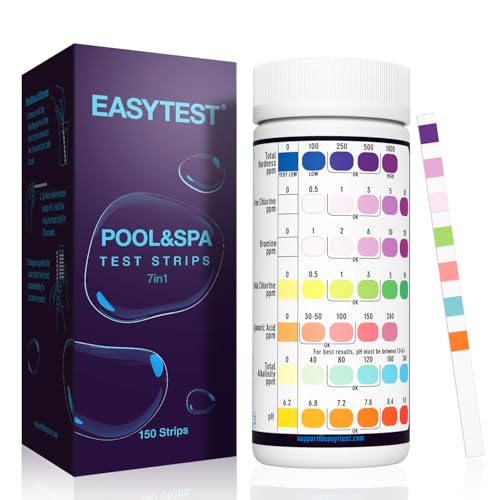
This 7-in-1 strip kit provides bromine, total alkalinity, pH, free chlorine, total chlorine, total hardness, and cyanuric acid results. It’s cost-effective and designed for quick checks, making it ideal for families or small facilities that need frequent monitoring without breaking the budget.
Best for: users who prefer quick, frequent checks with minimal setup. Limitation: color interpretation can vary by lighting; ensure consistent indoor lighting when comparing colors.
Poolmaster 22260 5-Way Test Kit
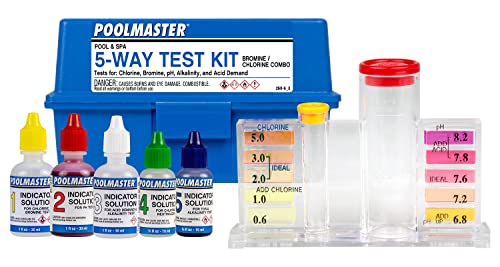
Poolmaster’s 5-way kit focuses on chlorine, bromine, pH, acid demand, and total alkalinity, with a clear-view test block and integrated color chips for precise matching. This kit is durable and simple to use, making it a solid choice for ongoing maintenance across residential pools and spas.
Best for: buyers who want easy color matching and a compact, durable kit. Caution: the kit includes multiple solutions; store as directed to avoid contamination or mix-ups between reagents.
Taylor K-1005 DPD, 9-in-1 Pool Test Kit

Taylor’s K-1005 9-in-1 kit includes reliable reagents for free and total chlorine, bromine, pH, acid/base demand, total alkalinity, calcium hardness, and cyanuric acid. The case and pictorial instructions simplify testing for households and professionals alike. Best for: users seeking a durable, USA-made option with broad parameter coverage. Limitation: reagent availability may require checking stock for off-season usage.
Taylor K-1004 DPD, 6-in-1 Pool Test Kit

This 6-in-1 kit provides quick checks for free and total chlorine, bromine, pH, acid demand, and total alkalinity. It comes in a compact setup with easy-to-use reagents and clear instructions. Best for: those who want essential parameters in a dependable, compact format. Caution: fewer parameters than 9-in-1 options, which may require supplementary testing for precise balance in complex water chemistries.
DROPLYTIX 10-in-1 Pool & Spa Test Kit

Droplytix offers a digital, app-enabled 10-in-1 test kit, measuring a broad range of parameters including chlorine, pH, alkalinity, hardness, nitrates, sulfates, cyanuric acid, and more. It supports testing across hot tubs, saltwater pools, and above-ground pools. Best for: tech-friendly buyers who want digital readings and app tracking. Caution: data readouts rely on the app; ensure your phone compatibility and app updates for accuracy.
Buying Guide: Key Purchase Considerations
- Testing Method: Choose between liquid-reagent kits, test strips, and digital/app-enabled kits. Liquid kits tend to be precise and widely trusted; strips are quick and affordable; digital kits offer digital readouts and trend tracking.
- Parameter Coverage: Determine which parameters you must monitor (chlorine, pH, alkalinity, calcium hardness, cyanuric acid, bromine, nitrates, etc.). 6-in-1 or 9-in-1 kits cover more bases with fewer tests.
- Ease of Use: Consider the learning curve, color chart clarity, and whether pictograms or step-by-step instructions help you test correctly.
- Durability and Storage: Look for sturdy cases, shelf life of reagents, and easy replacement parts to ensure long-term use across seasons.
- Maintenance Routine: Assess how often testing should occur. Some kits are best for twice-weekly checks, while digital kits can support continuous monitoring via an app.
- Compatibility: Ensure the kit works with your pool type (private residential, hot tub, spa, saltwater, above-ground). Some controllers are better suited for certain sanitizers (chlorine vs bromine).
FAQ
- What is the most accurate pool test kit?
– Accuracy depends on test method and user accuracy. Liquid-reagent kits from reputable brands and high-quality test strips with color references are consistently reliable for home use. Digital kits offer precise readings with app support. - Do I need all 9 parameters for a home pool?
– Not always. If your pool has stable chemistry, you may start with chlorine, pH, alkalinity, and cyanuric acid. Add calcium hardness and bromine as needed by your sanitizer and water source. - How often should I test pool water?
– Twice weekly testing is common for residential pools; more frequent testing may be needed after heavy rainfall, use of shock treatments, or seasonal changes. - Are digital test kits worth it?
– Digital kits reduce guesswork, provide faster results, and allow trend tracking. They can be especially helpful for saltwater pools or pools with variable chemistry. - Can I mix and match test methods?
– Yes, many homeowners use strips for quick checks and keep a liquid kit for periodic detailed testing or when precision is critical. - What should I do if test results are out of range?
– Follow the kit’s treatment guide for proper adjustments, re-test after a recommended wait time, and recalibrate if your kit supports it. If results remain high or low, reassess sanitizers, shock dosing, and water source inputs.