Yes, a wind and solar system kit can provide reliable off-grid power by combining solar charging with wind generation. This article helps buyers choose among top options for home, boat, cabin, or remote work sites. It highlights five versatile kits, explains who they’re best for, and compares capabilities like wind start speed, panel efficiency, and battery compatibility. Use this guide to select a system that matches your energy needs and climate, while avoiding kits that don’t serve your daily power profile.
| Product | Best For | |
|---|---|---|
| Giosolar 1120W Kit | Off-grid homes and remote cabins | 2x 100Ah Li batteries, 400W turbine, 6x 120W solar panels |
| VEVOR 1000W Kit | Small farms and boats | 6x100W panels, 400W turbine, LiFePO4 100Ah battery |
| AUECOOR 880W Kit | Rugged installations with solid weather resistance | 4x120W panels, 400W turbine, MPPT controller |
| Pikasola 400W Kit | Compact hybrid setups | 5-blade turbine, 12V system, marine/RV suitability |
| Lbxlhr 12000W Vertical System | High-output hybrid projects | Vertical axis, 3-phase PMG, wide voltage options |
The following sections review five top options. Each product includes who it’s best for, why it stands out, and a practical limitation to consider before purchase.
Giosolar 1120W Hybrid System Kit

Best for remote off-grid homes requiring a ready-to-use combo with substantial storage. This kit combines a 400W wind turbine with two 100Ah lithium batteries and six 120W solar panels, all integrated with a charge controller and a 3000W inverter. The wind turbine helps during night hours or overcast days when solar alone isn’t enough. It suits dwellings that need steady daytime and nighttime power, with a focus on self-sufficiency. A potential limitation is the size and weight of components for small installations or rooftop mounting.
VEVOR 24V 1000W Solar Wind Power Kit
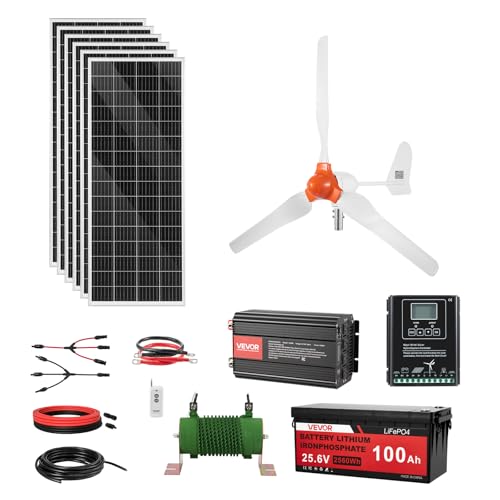
Best for versatile applications including homes, farms, boats, and cabins that need robust hybrid power. It includes six 100W panels and a 400W wind turbine plus a 100Ah LiFePO4 battery and 3000W inverter with an MPPT wind/solar controller. The kit emphasizes outdoor reliability and a broad operating temperature range, making it suitable for exposed locations. A caveat: the system’s total footprint may require more space for multiple panels and mounting hardware on non-traditional sites.
AUECOOR 880W Solar Wind Hybrid Kit

Best for durable, installation-ready setups where weather resistance is important. This kit features four 120W solar panels, a 400W wind turbine, and an MPPT-capable system. It notes durable construction with corrosion-resistant framing and pre-drilled mounting holes for quick installation. Choose this if you want easy integration with existing mounting systems. A limitation is that the included components may require compatible wiring and mounting accessories your site may not already have.
Pikasola 400W Wind Turbine Hybrid Kit

Best for compact hybrid systems in RVs, boats, or small cabins. It offers a 400W wind turbine with five blades and a 12V system, complemented by a charge controller for balanced solar-supplied energy. The longer wind blades improve power generation, and the nylon carbon fiber blades offer corrosion resistance. A limitation is that 12V systems may require more battery capacity planning for higher loads or future expansion.
Lbxlhr 12000W Vertical Wind System

Best for high-output hybrid projects where space and wind resources are favorable. This kit uses a vertical-axis wind turbine with three-phase PMG, offering a broad 12V–220V compatibility and an MPPT controller for efficient energy capture. It is designed to deliver long service life with a low-wind start and steady output. A consideration: such high capacity systems may require careful electrical design to ensure safe integration with existing grids or storage solutions.
Buying Guide: Key Purchase Considerations
- System size and energy needs: Estimate daily usage in kWh and match panel wattage, wind turbine rating, and battery storage accordingly. Larger homes or off-grid cabins benefit from higher capacity kits.
- Wind and sun resources: In consistently windy areas, prioritize turbines with low start-up speeds and robust blades. In sunny climates, panel efficiency and total panel area matter most.
- Battery chemistry and depth of discharge: Lithium options (LiFePO4) generally offer longer life and deeper discharge than lead-acid; ensure compatibility with the inverter and controller.
- Controller type: MPPT controllers maximize energy harvest, especially in variable conditions. Ensure the controller supports the combined solar and wind inputs and the system’s voltage.
- Mounting space and installation: Consider rooftop, ground-mount, or pole-mount options. Verify pre-drilled mounting compatibility and required hardware.
- Maintenance and durability: Look for corrosion-resistant frames, weather seals, and components designed for outdoor exposure. Noise and vibration of wind turbines can influence residential suitability.
- Expandability and future needs: Some kits offer easier add-ons (additional panels, batteries, or higher-capacity inverters) for growth without reworking the entire system.
Frequently Asked Questions
- What should I consider when combining wind and solar power at a remote site?
– Assess average wind speeds, sun exposure, storage needs, and the wiring layout to ensure safe and efficient energy sharing between sources. - Is a hybrid wind-solar kit suitable for beginners?
– Yes, but plan for proper mounting, electrical connections, and battery sizing. Start with a kit that includes a clear installation guide and compatible controller. - Do I need a separate inverter for wind and solar?
– Most hybrid kits use a single inverter for both sources if the controller and wiring are correctly matched to the system voltage. - Can these kits power critical loads during extended outages?
– They can support essentials if sized with sufficient battery storage and an appropriately rated inverter. - What maintenance is required for wind turbines?
– Regular inspection of blades, bearings, and wiring; ensure proper lubrication and secure mounting, plus routine checks after severe weather. - Are vertical-axis wind turbines better than horizontal-axis models?
– Vertical-axis models can be quieter and less sensitive to wind direction, but overall output depends on design, wind speed, and installation quality.