Find the right all-in-one beer brewing machine for your kitchen or basement. These units combine mashing, boiling, and often cooling in a single setup, simplifying all-grain brewing for hobbyists and small batches. The top picks below are ideal for beginners seeking easy automation and for seasoned brewers wanting precise control. This guide highlights who each model is best for and why they were selected.
| Product | Capacity | Best For | |
|---|---|---|---|
| VEVOR Electric Brewing System (9.2 Gal) | 9.2 gal / 35 L | Big batches, advanced control | Auto/Manual mode, 10 recipe memory, 25–100°C, 1–180 min |
| VEVOR Beer Brewing Equipment (8 Gal) | 8 gal / 30 L | Versatile home brewing with solid capacity | High-power, precise temp control, integrated inner barrel |
| VEVOR Beer Brewing Equipment (16 Gal) | 16 gal / 60 L | Larger gatherings, hobbyist pro-style | 7 programmable steps, recirculation pump, wort cooling coil |
| FOHERE All-in-One Electric (9.2 Gal) | 9.2 gal / 35 L | All-in-one novice to intermediate | 7-step mashing, 28.8 ft cooling coil, 10 recipe memory |
| VEVOR Automatic Home Beer Brewer (3.43 Gal) | 3.43 gal | Starter kits and compact setups | One-touch, 14 preset recipes, automatic hops timing |
VEVOR Electric Brewing System, 9.2 Gal

Best for: homebrewers who want high-capacity all-in-one control with recipe memory. This unit supports up to 8 gallons of finished beer from a single mash and boil cycle and includes an intelligent LCD panel with auto or manual operation. The 0.02-inch stainless inner pot handles grains reliably, and the 28.8-foot cooling coil speeds wort cooling after boil.
Why selected: It combines a large capacity with programmable steps and a long memory for up to 10 recipes, making it suitable for repeatable batches and experimenting with new recipes. A potential limitation is the setup complexity for absolute beginners.
Caution: The power range (100–1800W) requires careful handling to avoid overheating when fully loaded with grains.
VEVOR Beer Brewing Equipment, 8 Gal

Best for: social brewers and smaller batches with reliable temperature control. The 8-gallon kettle handles a variety of malts and styles and is designed for easy operation via the integrated electronic panel. It provides accurate mash temps and robust heating for efficient sugar extraction.
Why selected: The device’s balance of capacity, ease of use, and durable stainless components makes it a practical upgrade from basic kits. Limitation: May feel compact for larger malt bills or ambitious 5-gallon-plus recipes.
Caution: Ensure optimal venting when running at higher temperatures to avoid steam buildup in tight spaces.
VEVOR Beer Brewing Equipment, 16 Gal
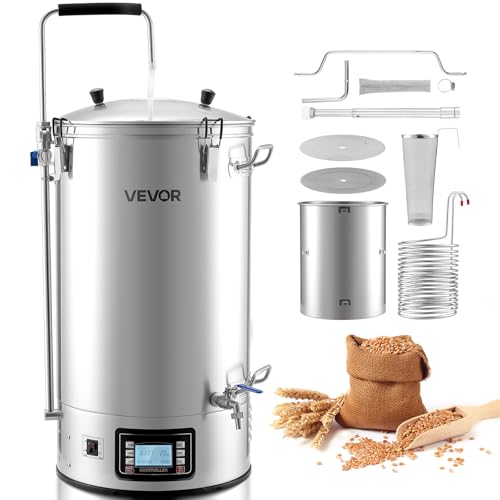
Best for: serious homebrewers or small-scale brewers needing high volume. The 16-gallon system includes a fast wort cooling coil and a recirculation pump to maintain even mash temperatures across larger batches. It stores up to 10 recipes and features a clear LCD control panel for power, temperature, and timing.
Why selected: It provides the largest batch size among the candidates here with programmable steps for precise mashing. Limitation: Higher upfront cost and footprint may require more space.
Caution: Heavy batches require solid support and proper handling to prevent tipping during transfers.
FOHERE All-in-One Electric Brewing System (9.2 Gal)

Best for: beginners moving toward all-grain technique with guided automation. This 9.2-gallon unit combines a 7-step programmable mash with a 28.8-foot cooling coil and a 10-recipe memory. It also automates hops timing for consistent aromas.
Why selected: The system emphasizes automation and memory, making it easier to repeat successful batches. Limitation: The included data indicates 1,800W max power; users brewing high-gravity beers should monitor performance with full loads.
Caution: The 10-recipe memory may require occasional backups or notes to prevent overwriting prior formulas.
VEVOR Automatic Home Beer Brewer (3.43 Gal)

Best for: entry-level home brewers who want one-touch automation and simplified steps. The device handles mashing, boiling, cooling, fermentation, dispensing, and bottling with preset recipes and a DIY mode for customization.
Why selected: The all-in-one approach reduces gear clutter and setup time, making it attractive for beginners. Limitation: The fermentation and bottling stages occur outside the primary kettle, requiring transfer steps for some users.
Caution: Brewing time can extend beyond the initial estimates when using DIY recipes or new ingredients.
Pinter 3 All-in-One (Fridge Friendly)

Best for: compact spaces and draft-style beer at home. The Pinter 3 serves as a compact, fridge-friendly all-in-one unit with a dock-and-tap system and a dedicated app for control. It’s designed for quick, small-batch brewing with an integrated dispensing tap.
Why selected: It showcases how all-in-one systems can fit in tight spaces while offering modern pour control. Limitation: It’s more of a mini-keg system, so batch size is limited compared with larger kettles.
Caution: Ingredient kits and accessory compatibility should be checked if you plan to scale up beyond small batches.
Mr. Beer Craft Beer Kit

Best for: absolute beginners who want a complete, simple introduction to craft beer making. This all-in-one kit includes fermentation equipment, ingredients, and bottles, enabling a streamlined start to finish.
Why selected: It provides a simple path to homebrewing without needing extensive gear or set-up. Limitation: It’s not a true all-in-one brewing machine for mashing and boiling; it’s a kit that simplifies the process from extract to foamier beer.
Caution: The kit relies on supplied ingredients, which may limit batch variety without additional kits.
Grainfather G30³ All-in-One

Best for: homebrewers seeking a versatile, app-connected system with a compact footprint. The Grainfather G30³ is an all-in-one electric setup designed for professional-quality craft beer at home and features wireless app connectivity.
Why selected: It combines a compact footprint with high-tech controls and proven performance. Limitation: As a premium option, it may require more space and investment than basic models.
Caution: App connectivity can require ongoing software updates and device pairing.
Buying Guide
What to consider when choosing an all-in-one beer brewing machine:
- Capacity and batch size: Choose a unit that fits your typical batch volume, whether 3–4 gallons for weekly homebrew or 8–16 gallons for larger gatherings.
- Programmable mashing: Look for multi-step programmable mashes if you want precise control over temperature profiles and sugar extraction.
- Cooling and wort handling: A built-in cooling coil or an efficient wort chiller reduces downtime between boil and fermentation.
- Automation and memory: Auto-hop timing, recipe memory, and preset programs help maintain consistency across batches.
- Ease of use: Consider whether you prefer one-touch automation or hands-on control with manual mode options.
- Space and footprint: Larger systems require more counter space and sturdy storage; match space with needs.
- Maintenance and parts: Stainless steel components and accessible cleaning paths reduce long-term upkeep.
- Upgrade path: Some systems offer additive accessories or upgrade kits for expanding functionality.
Frequently Asked Questions
- What is an all-in-one beer brewing machine?
An all-in-one unit combines mashing, boiling, cooling, and often fermentation or dispensing in a single chassis or linked modules, simplifying the brewing process for home use. - Who should buy a large-capacity all-in-one system?
Brewers who plan to make larger batches or host gatherings may benefit from higher capacity (8–16 gal) systems with robust pumping and efficient cooling. - Are automated features necessary for beginners?
Not strictly, but automation helps beginners achieve consistent results and reduces manual handling errors, especially during hopping and temperature control. - Can these machines replace separate kettles and chillers?
For many models, yes, but space and price considerations may influence whether a separate kettle or chiller remains preferable. - What maintenance is required?
Regular cleaning of the inner pot, filters, and cooling coil is essential; keep firmware and software up to date if applicable. - Which unit is best for small spaces?
Compact units like the Pinter 3 or 3.43 Gal options are ideal for fridge-friendly, space-constrained setups.