Ventless gas space heaters provide reliable warmth without venting, ideal for apartments, small living spaces, offices, and well-insulated garages. This guide highlights five top options, explaining who each is best for, and why they stand out. Use these concise comparisons to choose a model that matches space size, gas type, and safety needs. The buyer-friendly summaries below help you pick fast and confidently.
| Product | Best For | Key Reason |
|---|---|---|
| ProCom MN100TBA-B | Small living rooms and bedrooms | Compact 10,000 BTU, thermostat control, wall-mount or floor feet |
| ProCom MN180TPA-B | Medium rooms up to 950 sq. ft. | Infrared heat for broader warmth, slim profile |
| ProCom MN100TPA-B | Offices and cozy spaces | Infrared 10,000 BTU, wall-mount or base feet |
| Mr. Heater 30,000 BTU Vent Free | Garages and larger rooms | High BTU, expands heating quickly, battery ignition |
| ProCom MNSD300TGA | Garage or workshop | Dual fuel option, 30,000 BTU, thermostat control |
Note: All models listed are ventless and rely on natural gas or propane. Each product uses a thermostat or manual control to adjust heat output. When selecting, consider space size, fuel type, and installation preferences to maximize comfort and safety.
ProCom MN100TBA-B Ventless Blue Flame Heater

The ProCom MN100TBA-B delivers 10,000 BTU using natural gas and heats up to 500 sq. ft. It’s a compact blue flame model suitable for offices, bedrooms, living rooms, and other residential spaces. Thermostat control provides High, Medium, and Low settings, enabling steady comfort. The unit can be wall-mounted with included hardware or placed on the floor using base feet. This makes it a flexible choice for rooms with limited space. Best for: smaller rooms where quick warmth and adjustable heat output matter. Limitation: heat area is capped around 500 sq. ft., so larger rooms will require more capacity.
ProCom MN180TPA-B Ventless Infrared Plaque Heater

The MN180TPA-B provides 18,000 BTU and heats up to 950 sq. ft. Using infrared technology, it delivers direct warmth to people and objects, which can feel quicker and more efficient for larger spaces. Thermostat control supports High, Medium, and Low, allowing precise comfort. It’s designed with a slim, modern profile and can be wall-mounted or floor-based. Best for: medium rooms or living areas that need faster, more uniform heat. Caution: infrared models can feel hotter directly in front of the heat source, so position accordingly.
ProCom MN100TPA-B Ventless Infrared Plaque Heater

The MN100TPA-B is a 10,000 BTU infrared model that heats up to 500 sq. ft. It shares a compact, stylish design with slim mounting options. Thermostat control offers three heat levels for customizable comfort. It can be mounted on a wall or stood on base feet. Best for: spaces requiring modest warmth with flexible installation. Limitation: similar to other small units, cooling efficiency may lag in very large rooms.
Mr. Heater 30,000 BTU Vent Free Blue Flame

This model emits 30,000 BTU per hour and heats up to 1,000 sq. ft. It uses a battery-operated electronic ignition and requires no electricity to operate. It’s designed for quicker warmth in garages, workshops, or larger living spaces. Best for: larger rooms or garages needing substantial heat without external power. Caution: ventless operation means ensuring proper ventilation in enclosed spaces to maintain air quality.
ProCom MNSD300TGA Dual Fuel Ventless Heater
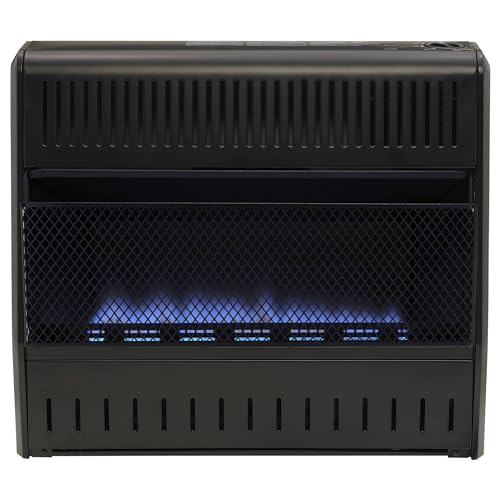
The MNSD300TGA provides 30,000 BTU and supports dual-fuel operation with natural gas or propane. It includes thermostatic control with adjustable settings and uses a patented dual-fuel technology to optimize efficiency. The unit is designed for garage environments or larger spaces where flexibility in fuel type is beneficial. Best for: spaces where propane is readily available or where future fuel switching might be desired. Limitation: dual-fuel systems can be more complex to service than single-fuel units.
Buying Guide: Key Considerations For Ventless Gas Heaters
Ventless heaters rely on indoor air to burn fuel safely. When choosing, consider space size, fuel type, and safety features. A larger BTU rating suits bigger rooms, while smaller units fit bedrooms or offices. Propane models are common in garages, but natural gas units require a gas line connection. Look for thermostats or adjustable heat settings to regulate comfort efficiently. Safety features such as oxygen depletion sensors, tilt switches, and flame failure devices help prevent unsafe operation. Installation flexibility—wall mounting or freestanding—affects space planning and aesthetics.
- What space size should you heat? Match BTU to room area: 5,000–10,000 BTU for small rooms, 15,000–30,000 BTU for larger spaces up to about 1,000 sq. ft.
- Which fuel is available? Natural gas requires a gas line; propane is common for off-grid setups and garages.
- Do you need a thermostat or manual control? Thermostats optimize comfort and energy use; manual controls simplify operation.
- Is safety feature coverage adequate? Look for oxygen depletion sensors, flame failure devices, and overheat/tilt safeguards.
- Where will you install it? Consider wall mounting or base feet; ensure proper clearance from combustible materials.
Quick Comparison At A Glance
- Best for small rooms: ProCom MN100TBA-B — compact and adjustable warmth in 500 sq. ft.
- Best for medium rooms: ProCom MN180TPA-B — infrared heat for broader coverage up to 950 sq. ft.
- Best for flexible fuel: ProCom MNSD300TGA — dual-fuel capability with 30,000 BTU
- Best for garages: Mr. Heater 30,000 BTU Vent Free — high heat output for larger spaces
- Best for office or small space: ProCom MN100TPA-B — infrared and slim profile
FAQ
- Are ventless heaters safe for bedrooms? Yes, when used as directed with proper ventilation and safety features such as an oxygen depletion sensor and tilt switch.
- Do ventless heaters require electricity? Some models have electronic ignitions; others operate without electricity using piezo ignition.
- Can I install these heaters on a wall? Yes, most models offer wall-mount capability or can sit on base feet.
- What maintenance do ventless heaters need? Regular inspection for gas leaks, clear vents, and checking safety sensors is advised.
- Can I run a ventless heater in a small apartment kitchen? It’s best to place in a living area or bedroom with adequate air exchange and follow local codes.