Answer: The right water pressure booster pump depends on your setting and needs. For homes, look for constant-pressure models with smart controls. For RVs and boats, choose compact, self-priming units with a reliable pressure switch. The five selected products deliver adjustable pressure up to 75 PSI, self-priming capability, and on-demand operation to maintain steady flow.
The following table compares the five top choices to help you pick quickly. All are designed to increase water pressure, with clear on-demand operation and reasonable lift heights for typical domestic, RV, or marine use.
| Product | Best For | Flow / PSI | Key Benefit |
|---|---|---|---|
| ECO-WORTHY 33-Series (RV, 50 PSI) | RVs and small boats | 4.0 GPM, 45–70 PSI | Smart pressure switch, quiet operation |
| AQUASTRONG Smart 45 | Whole-house, apartments | Up to 1500 GPH, 22–80 PSI | Constant pressure, integrated design |
| TDRFORCE 540E | Home and garden boosters | 5.5 GPM, up to 75 psi | On-demand, easy installation |
| ECO-WORTHY 110V Diaphragm Pump | Irrigation and garden | 5.5 GPM, 70 PSI | On-demand, thermal protection |
| 1/2 HP TDR Venus | Residential and lawn care | 14 GPM, up to 3.5 bar (≈50 PSI) | High flow, automatic control |
ECO-WORTHY 33-Series Industrial Water Pressure Pump
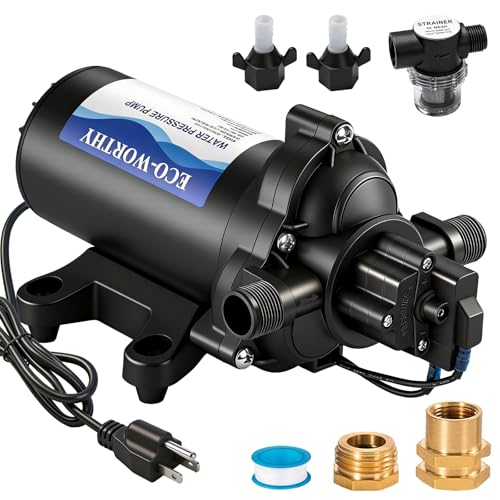
The ECO-WORTHY 33-Series is a 110V diaphragm pump designed for RV and small-boat use. It delivers 4.0 GPM at 50 PSI and features a smart pressure switch that starts and stops with faucet demand. It can adjust within 45–70 PSI and primes up to 9.8 feet, with a lift capacity up to 131 feet. Thermal overload protection guards the motor. Best for compact mobile setups where quiet operation and automatic on-demand pressure are priorities. Caution: avoid continuous full-load operation at extreme temperatures beyond design limits.
AQUASTRONG Smart 45 Whole House Booster

AQUASTRONG Smart 45 is a 115V integrated booster designed for homes and apartments. It provides constant pressure by automatically adjusting to demand, with a maximum head of 150 ft and up to 1500 GPH. The unit uses a stainless steel impeller and a maintenance-free pressure tank, plus rustproof components and a quiet operation (55 dB). It supports a pressure range of 22–80 PSI, with a preset around 44 PSI. Best for homes seeking stable, automatic pressure across multiple fixtures. Limitation: higher upfront cost relative to basic booster pumps.
TDRFORCE Fresh Water Pump 5.5GPM 75 PSI

TDRFORCE 540E models a 110V self-priming pump for boats, RVs, and garden hoses. It delivers up to 5.5 GPM and up to 75 PSI, with a maximum lift of 160 ft. The 3/4” inlet/outlet and 1/2” inlet connectors simplify installation, and the unit is designed for on-demand operation. Suitable for mobile setups where moderate to high flow is needed. Caution: ensure compatible piping and avoids overloading higher head requirements beyond rated lift.
ECO-WORTHY 110V Transfer Diaphragm Pump

This ECO-WORTHY model handles 5.5 GPM at 70 PSI with a 110V supply. It has a self-priming capability up to 9.8 feet and a lift up to 131 feet. The pressure switch is set to 70 PSI and can be adjusted. It includes thermal protection for safer operation. Best for irrigation and garden setups that require reliable on-demand boosting with moderate head. Limitation: noise level and heat can rise with longer runs.
TDR Venus 1/2 HP Household Booster

The TDR Venus 1/2 HP pump is designed for domestic use with up to 14 GPM flow and a maximum lift of 105 feet, delivering up to about 3.5 bar (50 PSI). It leverages automatic control to start when water runs and stop when not needed. Best for large households or lawn irrigation where higher flow helps multiple fixtures simultaneously. Limitation: higher flow may draw more power and create more vibration than smaller units.
Buying Guide: Key Considerations For Water Pressure Boosters
What should you look for when selecting a water pressure booster?
- Pressure range and stability: Choose a unit with a pressure range appropriate for your fixtures (usually 22–80 PSI). A constant-pressure model helps maintain steady flow across multiple taps.
- Flow rate and head: Higher GPM and greater maximum head benefit larger homes or gardens. For RVs or boats, prioritize compact size and on-demand operation.
- Self-priming capability: Self-priming pumps simplify installation in systems with variable suction heads or tanks located above the pump.
- Smart/automatic controls: A built-in pressure switch or smart controller improves on-demand performance and reduces unnecessary pumping.
- Temperature and safety features: Look for thermal overload protection to protect the motor, especially in hot climates or long operation cycles.
- Installation flexibility: Check inlet/outlet fitting sizes (commonly 1/2″ or 3/4″) and cord length for easy mounting and wiring.
- Quiet operation: Noise can be a factor in living spaces or boats; some models emphasize quiet performance.
- Durability: Stainless steel or corrosion-resistant components benefit lifetime reliability in damp or outdoor environments.
Practical Scenarios: Which Pump Is Right For You?
- Small RV or marine setup with limited space: Choose a compact unit with a 45–70 PSI range and self-priming action, such as the ECO-WORTHY 33-Series.
- Whole-house boost in apartments or small homes: A smart, constant-pressure model like AQUASTRONG Smart 45 helps maintain even pressure across all fixtures.
- Garden irrigation and lawn care: A 5.5 GPM unit with moderate PSI (around 70 PSI) can be effective, such as ECO-WORTHY 110V Transfer or TDRFORCE variants.
- High-demand households with multiple bathrooms: A higher-flow model with robust head and a dependable control system supports simultaneous taps without drops in pressure.
- Shallow well or surface water reliance: Look for models with good lift height and efficient self-priming, ensuring reliable startup even with longer suction lines.
FAQ: Quick Answers About Water Pressure Boosters
- What PSI is best for a residential home?
Most homes benefit from 40–60 PSI at most taps; consider models that provide a stable 44–50 PSI with adjustable range.
- Do I need a booster with a storage tank?
Not always. On-demand booster pumps regulate pressure without a storage tank, but tanks can smooth pressure fluctuations in some setups.
- Can these pumps run continuously?
Many are designed for intermittent operation tied to faucet use. Thermal protection and automatic shutoffs help protect the motor when not needed.
- Will higher GPM hurt my plumbing?
Excessive flow can cause leaks if pipes, fittings, or valves aren’t rated for the increased pressure. Match pump capacity to system limits.
- Is self-priming essential?
Yes for installations where the pump sits above the water source or in systems without a constant water feed at the pump.
- How do I choose between constant-pressure vs. on-demand pumps?
Constant-pressure pumps maintain steady pressure at all times; on-demand units save energy by running only when water is used. Choose based on fixture usage patterns and noise tolerance.