If you want clear, real-time CO readings paired with reliable alarms, these detectors with digital readouts are ideal. They’re suited for homeowners seeking easy installation, visible CO levels, and dependable alerts during power outages. The top picks include plug-in models with battery backups for continuous protection, portable options for travel, and long-life battery units for low-maintenance safety. This guide highlights five models that balance accuracy, visibility, and ease of use for different living situations.
Summary table of chosen products
| Product | Type | Best For | Notes |
|---|---|---|---|
| Kidde Plug-In With 9V Backup (3rd Edition) | Plug-in with battery backup | Homes with reliable 120V outlets | Digital display shows CO levels |
| Kidde AA Battery Powered with LEDs | Portable AA-powered | Renters; travel-ready safety | No wiring needed |
| Kidde Plug-In With AA Backup (5th Edition) | Plug-in with battery backup | Homes needing ongoing detection during outages | Rotating plug; digital display |
| X-Sense SC07 | Combo smoke/CO detector | CO and smoke in one unit; 10-year power | Standalone; no wireless interconnection |
| Kidde 10-Year Battery Powered (3rd Edition) | 10-year battery powered | Low maintenance; long-term installations | Digital display; no wiring |
Kidde Carbon Monoxide Detector, Plug-In With 9V Backup

Best for: Homes with standard 120V outlets and a need for network reliability during outages. This model plugs into a wall outlet and includes a 9-volt battery backup for continued CO detection when power is out. The digital LED display shows current CO levels, making it easy to monitor increasing risk. It’s well-suited for bedrooms or living rooms where a visible, real-time readout is valuable. A potential limitation is that it relies on a home outlet; if the outlet is absent or in a difficult location, placement may require an extension solution.
Kidde AA Battery Powered CO Alarm With LEDs
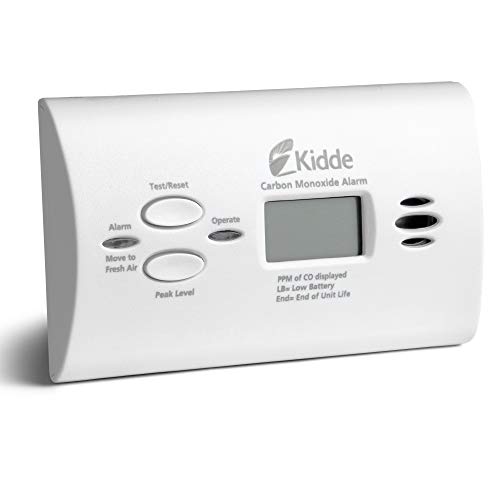
Best for: Renters or travelers who need a portable CO detector with battery operation. This model uses an electrochemical sensor to detect CO, with two AA batteries included for outages. It’s easy to mount on a wall or place on a table. The simplicity is advantageous for temporary living situations. A caveat is that battery replacement will be needed periodically, and readings aren’t as seamless as plug-in units with constant power UX during long outages.
Kidde Carbon Monoxide Detector, Plug-in With AA Backup

Best for: Homes that want continuous 120V detection with an added AA backup for outages. This unit features a backlit digital display that makes CO levels easy to read in dim light, plus a rotating plug to fit vertical or horizontal outlets. It includes LED status indicators for quick hazard checks. A limitation to consider is its reliance on wall outlets; placement may be constrained by room layout.
Kidde Carbon Monoxide Detector, Plug In Wall With 9-Volt Battery Backup, Digital LED Display – 2 Pack

Best for: Homes seeking reliable wall-mounted CO protection across multiple rooms with a straightforward two-pack solution. It operates on 120V and includes a 9V battery backup. The digital LED display provides ongoing CO readings. A consideration is that the unit’s effectiveness depends on outlet availability and placement in central areas for optimal detection coverage.
X-Sense Smoke and CO Detector Combo, SC07

Best for: Homes needing a combined smoke and CO detector in one device with extended power. The SC07 uses a sealed lithium battery delivering up to 10 years of power, reducing the need for frequent maintenance. It’s a solid choice for residents prioritizing long-term reliability without battery changes. Note that this model is standalone; it does not interconnect with other alarms or bases, which may limit networking capabilities in larger homes.
Kidde Carbon Monoxide Detector, 10-Year Battery Powered

Best for: Long-term installations in homes prioritizing minimal maintenance. This 10-year battery-powered unit provides continuous CO detection with a backlit digital display that updates every 15 seconds. It eliminates the need for battery changes for the life of the unit, while still offering a reliable alarm at 85 dB. A potential drawback is replacement timing: after a decade, the unit should be replaced rather than serviced.
Kidde AA Battery Powered CO Detector, COBDL

Best for: Those who want early low-level CO alerts with a readable LED and a test/hush function. This model emphasizes low-level CO detection (around 30-70 ppm) to help safeguard vulnerable populations before CO reaches higher levels. It runs on two AA batteries for outages. A consideration is that it relies on battery power, so battery health affects long-term performance and monitoring continuity.
Buying Guide: Key Purchase Considerations
- Power source: Choose plug-in with battery backup for continuous protection during outages, or battery-only for easy placement without wiring.
- Readout visibility: Digital backlit displays help you monitor CO levels at a glance, especially in bedrooms or hallways with low lighting.
- Sensor type and lifetime: Electrochemical sensors provide accurate readings; consider units with long-life batteries (10-year options) to reduce maintenance.
- Installation practicality: Rotating plugs and wall-mount options improve placement flexibility; portable detectors are ideal for travelers or renters.
- Alarm features: 85 dB alarms are common; look for LED indicators and test/hush functions to verify operation and momentarily silence alerts when safe.
- Interconnection: If you need multiple alarms to work in sync, ensure the model supports interconnection or choose a system that offers scalable networking.
Frequently Asked Questions
- Do digital CO detectors require calibration? Most consumer CO detectors do not require user calibration, but periodic testing with the own test button is recommended.
- What does a CO reading of 70 ppm mean? Prolonged exposure above 70 ppm is considered hazardous; evacuate and call emergency services if readings rise and persist.
- Can I use a CO detector with a home alarm system? Some detectors are standalone; others can interconnect or tie into home safety systems. Check product specifications for interconnection support.
- How long do CO detectors last? Battery-powered units vary by battery type; long-life models use 10-year batteries, while others require periodic battery replacement.
- Is a combination smoke/CO detector better than separate units? A combo unit saves space and simplifies installation, but ensures both sensors are properly maintained and tested.
- What’s the importance of a digital CO readout? A digital readout provides exact CO levels and helps gauge risk over time, supporting timely evacuation decisions.