Laminar hood air flow is essential for sterile work, especially in mycology, tissue culture, and cleanroom tasks. The right cabinet provides stable, directional airflow that minimizes contamination risk. This guide highlights five top picks, explains who they’re best for, and compares key features so you can choose confidently.
| Product | Best For | Key Feature | Notes |
|---|---|---|---|
| Laminar Flow Hood with H13 HEPA Filter (20″x15″) by Shroomagic | Professional mycology and sterile lab work | H13 HEPA filter, 249 CFM, dual fans, built-in LED | Compact 20″ footprint; suitable for inoculation tasks |
| HEPA H14 Laminar Flow Hood by FAFAGLGL | ISO Class 5 cleanroom-grade tasks | HEPA H14, 46.2″x22.6″x11.37″, three-speed control | High filtration, larger work surface |
| YJINGRUI Laminar Flow Hood H-14 | Clean rooms and research labs needing stringent ISO 5 | H-14 HEPA, 22.6″x22.6″, adjustable speeds | Balanced performance and size |
| Laminar Flow Hood with HEPA H12 by YFTOHI | Budget-friendly mycology and lab tasks | HEPA H12, 17.3″x14.8″ footprint, LED + dual fan | Smaller size; best for light use |
Note: The following sections describe five relevant options in detail to help you compare suitability for your workflow, space, and cleanliness requirements.
Laminar Flow Hood with H13 HEPA Filter by Shroomagic

Best for professional mycology and sterile operations. Size: 20 × 16.8 × 7.9 inches; working area 20 × 15 inches. Airflow velocity ranges 0.35–0.5 m/s with up to 249 CFM. It uses an H13 HEPA filter that removes 99.95% of 0.3 µm particles, providing reliable sterility for inoculation, agar transfers, and culture work. Dual DC brushless fans support stable laminar flow, and a built-in LED light enhances visibility during delicate tasks.
Who this is for: labs and cultivators needing a compact cabinet with strong sterile performance and daylight illumination. Caution: ensure adequate space for airflow access and consider filter replacement when maintenance is due.
MSFULLSEA Laminar Flow Hood HEPA Filter

Best as a budget-conscious option for hobbyists and entry-level DIY projects. It uses a three-layer filtration system, including HEPA and natural fiber layers, to create directional clean air. It is not labeled as a certified laminar flow hood, so it is best for basic cleaning and inoculation needs rather than ultra-cleanroom environments. A silent DC fan setup supports stable airflow, and the included HEPA layer is designed for easy replacement.
Who this is for: beginners or makers needing a cost-effective setup for simple clean tasks. Caution: not a certified ISO/Class 100 hood; expect less dust-free assurance than professional units.
HEPA H14 Laminar Flow Hood by FAFAGLGL
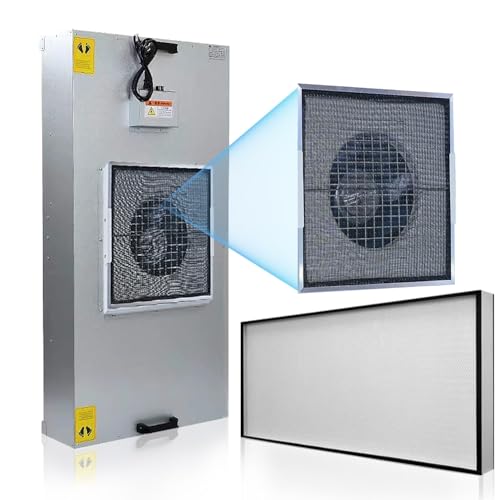
Best for ISO Class 5 clarity in laboratories and mushroom rooms. The unit features a HEPA H14 filter and a large work area (46.2″ × 22.6″ × 11.37″). It delivers a laminar flow with adjustable speeds and a high filtration efficiency of 99.995% for particles 0.3 microns and larger. The design emphasizes durability with galvanized framing and a thick metal casing. It provides a three-speed flow adjustment and a wide range of airflow options.
Who this is for: research facilities and production spaces needing high-grade clean air and a broader workspace. Caution: larger footprint requires more installation space.
YJINGRUI Laminar Flow Hood H-14

Best for environments demanding ISO Class 5 cleanliness, such as advanced mushroom cultivation and tissue culture. This hood uses an H-14 HEPA filter, with dimensions 22.6″ × 22.6″ and adjustable air speeds. It delivers a laminar flow that can filter 99.995% of 0.3 µm particles, helping maintain sterile work surfaces during inoculation and culture handling. It balances size and performance for mid-to-large scale lab tasks.
Who this is for: labs requiring reliable ISO 5 conditions in a compact footprint. Caution: verify power and space requirements before purchase.
Laminar Flow Hood with HEPA H12 by YFTOHI

Best for entry-level mycology work and labs seeking a smaller, affordable option. The hood includes a HEPA H12 filter, dual fans, LED lighting, and a compact 17.3″ × 14.8″ × 14.8″ workspace. It offers adjustable speed and a quiet operation profile, making it suitable for hobbyists or small-scale inoculation tasks.
Who this is for: budget-minded users with limited space. Caution: not ideal for high contamination risk tasks requiring ISO Class 5 or 100 cleanliness.
Buying Guide
- What level of cleanliness do you require? If you need ISO Class 5 or better, prioritize H14 or H13 HEPA filters from reputable brands.
- What is your available space? Larger work surfaces demand more room for equipment and airflow; select cabinets with dimensions fitting your bench.
- Are you performing delicate inoculations or culture transfers? Look for built-in LED lighting and stable dual-fan systems to minimize air disturbances during operations.
- Do you need certified laminar flow? Some models claim laminar flow without certification; opt for units explicitly stating ISO/Class 5 or ISO Class 7 as appropriate for your workflow.
- What is your budget and maintenance plan? Cheaper units may have shorter service life or easier-to-replace components; budget for replacement filters and fan wear.
- Are there specific power requirements? Check voltage compatibility (110V typical in the U.S.) and whether a selector is needed for different outlets.
FAQs
What is the difference between H13 and H14 HEPA filters?
Both remove particles down to 0.3 microns, but H14 offers higher filtration efficiency (99.995%) than H13 (99.95%), aiding more stringent clean conditions.
Is a certified laminar flow hood necessary for mushroom cultivation?
For professional, contamination-sensitive work, a certified laminar hood with ISO 5 or Class 100 specification is preferable.
Can I use any laminar hood for tissue culture?
Use a hood with appropriate filtration and airflow characteristics; ensure the hood size and flow speed match your tissue culture needs.
How often should filters be replaced?
Replacement intervals depend on usage, environment, and manufacturer guidance; monitor airflow and particle counts to decide.
Do these hoods require professional installation?
Most units are designed for bench-top use but may require proper mounting, electrical safety checks, and venting if applicable.