Find the right lab scale for precise weighing in scientific, educational, or jewelry applications. This guide highlights five reliable options across a range of capacities and readability, so you can pick a model that matches your workflow, whether you need high-precision 0.01 g measurements or broader 5000 g capacity. Each product is suited to different buyers: basic educational use, jewelry and metalwork, or professional lab work. The table below offers a quick snapshot of the top picks.
| Product | Capacity | Readability | |
|---|---|---|---|
| Bonvoisin Digital Scale 6000g | 6000 g | 0.1 g | General lab work, jewelry, and quick checks |
| Bonvoisin Lab Scale 5000g | 5000 g | 0.01 g | Precise analytical weighing, jewelry, science classrooms |
| RUISHAN Lab Scale 5000g | 5000 g | 0.01 g | Research, chemistry, pharmacy, jewelry |
| SASVY 1000 g Scale | 1000 g | 0.01 g | Laboratory work and teaching with compact size |
| SASVY 5000 g Scale | 5000 g | 0.1 g | Broader weighing in school and shop environments |
Bonvoisin Digital Scale 6000g 0.1g

Capacity is 6000 g with a 0.1 g readability, suitable for quick, everyday lab tasks. The scale offers six units: g, oz, lb, kg, tl, and ct. Its stainless steel weighing pan and clear LCD display support straightforward operation in busy lab environments. Best for general lab work, jewelry weighing, and classrooms that need fast readings. A potential limitation is slightly coarser 0.1 g resolution compared with higher-precision models.
Bonvoisin Lab Scale 5000gx0.01g
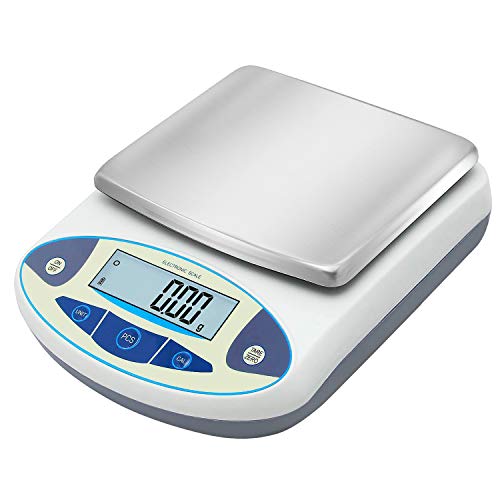
This model offers 5000 g capacity with 0.01 g precision and a large 180×140 mm stainless steel pan. It supports high-sensitivity sensor readings, adjustable feet, level bubble, overload alarm, and external calibration. Best for jewelry, powders, and small-item weighing where accuracy is critical. Use caution with weights during calibration to maintain accuracy over time; the data emphasizes calibration steps rather than built-in automatic calibration.
RUISHAN Lab Scale 5000g 0.01g

With a 5000 g capacity and 0.01 g accuracy, this scale uses a high-sensitivity built-in sensor and a large 170×170 mm stainless steel pan. It supports multiple unit conversions and functions such as tare and counting. It is well-suited for laboratories, schools, jewelers, and small businesses. The model notes a preheating requirement and external calibration for best results, making it ideal when calibration routines are part of the workflow but requires a short setup period before use.
SASVY Digital Lab Scale 1000g x 0.01g

Offers 1000 g capacity with 0.01 g readability, backlit LCD, and multiple units (oz/g/ct/dwt/tl/gn/ozt). It includes a 100 g calibration weight for accuracy maintenance and supports tare, counting, and calibration. Best for science labs and small jewelry tasks where precise, repeatable measurements are needed and calibration weight is advantageous for ongoing accuracy.
WELLiSH Lab Scale 5000g 0.01g

This 5000 g capacity scale delivers 0.01 g precision with a large 7.87×5.51 inch weighing pan. It supports 17 units (including g, ct, oz, lb) and dual power options. The device emphasizes stable readings and a clear LCD display. It is a good pick for laboratories and classrooms that require a broader unit range and consistent performance, though users should confirm included calibration weights before use.
Srora Lab Scale 500g 0.001g

This compact model weighs up to 500 g with 0.001 g precision and includes a windshield to minimize air disturbance. It supports 13 unit conversions and offers tare, memory, counting, and calibration features. Best for high-precision micro-weighing in chemistry or jewelry, but its lower capacity makes it unsuitable for heavier samples.
Buying Guide: Key Purchase Considerations
Capacity and readability should match the expected sample mass and required precision. If weighing precious metals, choose 0.01 g or better with a stable, level surface and calibration options. Unit flexibility (g, oz, ct, lb, kg, ozt, dwt, etc.) helps streamline cross-application tasks. A large, durable weighing pan aids handling small items like powders, beads, or jewelry. Look for a stable, level footing and clear display for quick reads in dim lab spaces. Consider whether you need a built-in calibration weight, a rechargeable battery, or a convenient tare function for repeated measurements.
Calibration and maintenance are crucial for long-term accuracy. Scales with external calibration or an included calibration weight allow routine checks. If your environment has air currents or vibration, models with windshields or protective enclosures can improve stability. For teaching labs or classrooms, a compact scale with multiple units and a simple interface reduces setup time and increases reliability. Always verify whether the included accessories meet your standard workflows before purchasing.
Frequently Asked Questions
- What capacity should I choose for jewelry weighing? Choose a scale with sufficient capacity and a tight readability, such as 0.01 g or 0.001 g precision at scales around 2000–5000 g, to accurately weigh small metal items.
- Do I need a calibration weight? A calibration weight helps maintain accuracy over time, especially in busy labs or when measurements are critical.
- Is a windscreen necessary for lab scales? Windshields reduce air disturbances and improve stability for high-precision measurements, particularly in drafty environments.
- Can I use these scales for kitchen measurements? Some scales support units like g and oz, but they are designed for laboratory accuracy. For culinary use, ensure the scale’s readout and calibration are appropriate for food weighing.
- The tare function resets the display to zero when a container is placed on the pan, enabling net weight measurements.
- A backlit LCD display improves readability in dim labs and classrooms, reducing measurement errors.