Answering today’s buyer intent: these model engine casting kits offer realistic, metal-built educational experiences that suit hobbyists, students, and STEM educators seeking hands-on understanding of engine mechanics. The top picks below are best for learners who value durability, authentic parts, and visible operation. Each entry highlights who benefits most, plus practical limitations to consider.
Summary Table
| Product | Best For | Key Feature | Notes |
|---|---|---|---|
| TECHING V8 Engine Model Kit | Adults and serious hobbyists | 500+ parts, working 4-stroke system | Complex; patient assembly required |
| TECHING Jet Engine Model Kit (DM119) | Aviation enthusiasts | 1/10 scale, motor-driven with sound | Higher part count |
| TECHING Mini Diesel Engine DM-115 | STEM classrooms, family projects | OHV 4-cylinder diesel, 300+ parts | Smaller scale, detailed |
| DM122 Mini Metal Turbofan Engine | Display and demonstrations | All-metal, transparent cover option | Viewing window enhances learning |
| TECHING V4 Engine Model Kit | Beginners and young learners | 350+ parts, clear instructions | Simpler than V8 variants |
TECHING V8 Engine Model Kit That Works

Best for: Serious learners and hobbyists who want a highly detailed, functional V8 engine model. The kit includes precision-cast and machined parts in anodized aluminum and stainless steel, closely mirroring modern high-performance engines. A real electric motor drives the 4-stroke cycle for realistic observation of crankshaft, rods, pistons, and valve-trains. The assembly is complex but rewarding for those pursuing engineering fundamentals in a tangible way.
Why selected: It combines authentic materials, a large part count (500+), and a full-color instruction manual. The viewing windows and moving components help users visualize internal mechanisms, enhancing comprehension of engine timing and synchronization.
Caution: The kit’s complexity may require patience and time; beginners should plan longer assembly sessions and follow the step-by-step guide carefully.
TECHING Jet Engine Model Kit Twin-Spool (DM119)

Best for: Aviation enthusiasts and learners who want a visible, motor-driven jet engine with authentic components. The kit reproduces a full-scale engine’s major stages, including a first-stage fan, multiple compressors, and turbines, with a robust metal build and surface treatments for durability.
Why selected: It emphasizes realism through CNC machining, precision casting, and anodized coloring, delivering a highly durable model with dynamic, observable operation via a motor-driven setup.
Caution: The 1000+ piece count makes this a longer-term project; ensure adequate space and time for completion and testing.
TECHING Mini Diesel Engine Model Kit DM-115

Best for: Families and classrooms seeking a compact yet informative diesel engine model experience. With 300+ parts and a clear instruction manual, builders can observe how an OHV inline four-cylinder diesel operates from disassembly to assembly.
Why selected: The set emphasizes mechanical education and creative engagement, fostering thinking skills and collaboration on a tangible project.
Caution: Smaller components require careful handling to avoid misplacing parts during assembly.
DM122 Mini Metal Turbofan Engine Model Kit
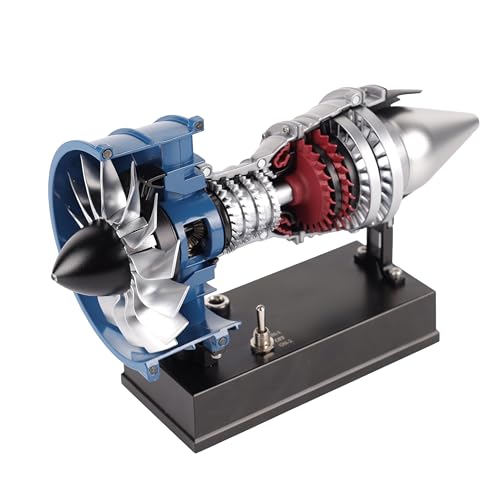
Best for: Demonstrations and display-focused learning. This all-metal turbofan features a semi-transparent, quick-release magnetic casing to reveal internal mechanics when powered by the included motor setup.
Why selected: The transparent components and external mounting bracket provide a clear, engaging view of engine operation, making it an excellent showpiece for STEM classrooms and desk displays.
Caution: The model’s internal parts can be delicate; handle the magnetic cover gently during assembly and disassembly.
TECHING V4 Engine Model Kit

Best for: Beginners and younger learners starting with a robust but approachable engine model. The kit includes over 350 parts and a clear set of instructions to guide learners through a complete engine assembly experience.
Why selected: It serves as a gateway kit into engine mechanics, offering a balance of part quality, instructional clarity, and a satisfying final display model.
Caution: While simpler than the V8 options, it still requires careful following of steps to ensure correct alignment of components.
Buying Guide
What should I consider when choosing a model engine kit?
Material quality matters for durability and realism. Look for metal parts (aluminum, stainless steel) and precision machining. A clear viewing window or transparent casing helps visualize internal mechanisms.
How many parts is right for me?
Newcomers may prefer 300–350 parts for a complete but manageable build. Intermediate to advanced builders can tackle 500+ parts for deeper learning and longer projects.
Is a working model important?
Working models with an electric motor or a combustion-like simulation provide dynamic learning opportunities, showing how pistons, crankshafts, and valves synchronize in motion.
What setup considerations exist?
Ensure sufficient space for assembly and display. Consider the enclosure or casing for safety and presentation, especially for younger builders or classrooms.
Which kit is best for classrooms or family projects?
Kits that emphasize assembly guidance, durable construction, and a clear learning guide are ideal for group activities and self-guided learning at home or in school settings.
FAQ
- Do these kits run as working engines? Some kits include motorized or simulated operation to demonstrate motion; others focus on static assembly and display.
- Are all parts clearly labeled? Yes, most sets provide labeled components and an English instruction manual to aid assembly.
- What skill level is required? Basic mechanical understanding helps, but several kits are designed to build up from beginner to advanced over time.
- Can these be used in classrooms? Many kits are suitable for classrooms or family projects, offering engaging STEM learning experiences.
- Are replacements parts available? Replacement parts are typically available through the manufacturer or seller for ongoing projects.
- Do these require tools? Some kits include all necessary parts and tools; others may require common household implements for assembly.