Looking for reliable anatomical charts and models to support teaching, patient education, or personal study? This guide highlights five top options that balance detail, durability, and display value. Each pick is explained for who it’s best for, with practical notes to help you choose. The selections cover full skeletons, foot and brain models, muscular and skeletal posters, and a color-coded skull model to aid quick identification. Use the overview table to compare at a glance and then read detailed sections to understand why each model stands out for different buyers.
Overview Of Selected Products
| Product | ||
|---|---|---|
| 2026 New Medical Anatomical Human Skeleton Model | Medical study, classroom display | Life-size, fully articulated with nervous system detail; rolling stand for easy mobility |
| NEW HORIZON Natural Large Foot Anatomical Model | Foot anatomy education for students and patients | 9-part model showing muscles, ligaments, nerves, vessels; realistic texture |
| Palace Learning Muscular & Skeletal Poster Set | Wall charts for classrooms and clinics | Durable laminated posters; quick reference for muscles and skeleton |
| Medarchitect Colored Skull Model | Skull anatomy study for students | 22 bones in 9 colors for rapid identification |
| ZENFUN Brain Anatomical Model | Brain anatomy education and patient demonstrations | Color-coded lobes and regions; compact and durable |
2026 New Medical Anatomical Human Skeleton Model

Best for: medical students, clinicians, and instructors needing a life-size reference with full articulation. This model has 206 bones, a detachable skull cap, and a rolling stand for easy movement between learning spaces. It supports detailed study of individual bones and joint movements, making it a robust centerpiece for classrooms and clinics. The non-toxic PVC build promises straightforward maintenance and cleaning, while its assembled standing pose helps demonstrate posture and alignment. A potential limitation is that its size and weight require space and care during transport.
NEW HORIZON Natural Large Foot Anatomical Model

Best for: podiatry students, physical therapists, and clinicians focusing on the foot and lower limb. The 9-part foot model reveals muscles, ligaments, nerves, and arteries, with clear textures for landmark teaching. It’s ideal for patient education and classroom demonstrations about common injuries and foot mechanics. A consideration is that it emphasizes the foot specifically rather than full-body anatomy, so users needing broader coverage should pair it with a larger model.
Palace Learning Muscular & Skeletal Poster Set

Best for: classrooms and clinics that need durable, quick-reference wall charts. The laminated 18″ x 24″ posters provide a clear overview of muscular and skeletal systems with tear-resistant durability. They’re easy to frame or pin in teaching spaces and can supplement hands-on models. A limitation is that charts do not offer the tactile understanding that three-dimensional models provide, so combine with physical models for deeper learning.
Medarchitect Colored Skull Model
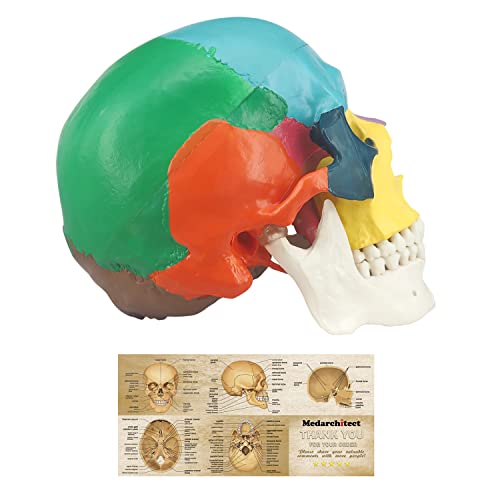
Best for: medical students and educators who need quick bone identification. The skull model uses 22 individual bones in 9 bright colors to distinguish regions, aiding memorization and reference during lectures. A caveat is that color coding may not reflect natural hues found in some advanced clinical contexts, so cross-reference with real skull images for comprehensive study.
ZENFUN Brain Anatomical Model

Best for: science classrooms and introductory neuroscience education. The brain model is color-coded by regions and labeled for easy identification. Its PVC construction is durable for frequent handling, and its compact size supports portable demonstrations. A limitation is that it represents a simplified, scaled model rather than an immersive, full-brain replica, so use it alongside additional resources for advanced studies.
Buying Guide
What should you consider when choosing anatomical charts and models?
Purpose: Identify whether you need a full-body skeleton, regional models, or wall charts to suit a teaching or patient-education setting.
Size, detail, and durability
Life-size models offer realistic demonstrations, while smaller models are portable. Laminated charts resist wear, and durable plastics or PVC support long-term use in classrooms and clinics.
Mobility and display
Rolling stands and lightweight bases enhance classroom versatility. Wall charts stay put on display walls, ideal for waiting areas and lecture halls.
Color-coding and labeling
Color-coded bones and regions speed identification for students. Ensure labeling is clear and consistent with your curriculum.
Maintenance and safety
Non-toxic materials simplify cleaning. Detachable parts should be inspected for secure assembly to prevent hazards during demonstrations.
How to combine products for a complete setup
Pair a full skeleton with regional models (foot, brain, skull) and laminated charts to cover both tactile and visual learning. This approach supports varied learning styles and enhances retention.
Frequently Asked Questions
- Which model is best for a basic anatomy classroom? A combination of posters and a compact brain or skull model provides quick references and hands-on learning without overwhelming students.
- Are color-coded skulls necessary? They help with rapid identification of bones, which is useful for beginners. For advanced study, supplement with unlabeled references.
- Can these models be moved between classrooms? Yes, models with rolling stands or portable frames are designed for easy relocation.
- How durable are laminated charts? Laminated charts resist tearing and spills, making them suitable for busy learning spaces.
- What should I buy if I need both feet and full-body anatomy? Start with a life-size skeleton and add targeted regional models, such as a foot model and a brain model, to cover both full-body and localized study.
- Is color coding standard across models? Color coding varies by product; check each listing to understand the color scheme and ensure it aligns with your curriculum.